The hire felt like progress. A marketing manager, a content writer, an ads specialist, an analyst. Four desks, four salaries, a Slack channel that pinged all day. Twelve months later the founder sat in front of a flat growth chart and a payroll line creeping toward half a million dollars, asking a quiet question: where did the momentum go?
Here's the part nobody put on the budget. The most expensive thing about that team was never the salaries.
The number you can see
Start with the math, because it's worse than most owners expect. In the US, a four-person marketing team can easily cost $450,000 to $550,000 a year once salaries, benefits and payroll taxes are included. Then come the parts that hide in other budgets. Software and data tools push past fifty thousand dollars annually. Recruiting fees. Onboarding months. The manager's hours spent managing. None of it ships a single campaign.
An outside team covering the same ground tends to land at a fraction of that, often well under a third, because the cost is spread across many clients instead of carried by one.
That gap is real, and it's the easy argument. The harder one sits underneath it.
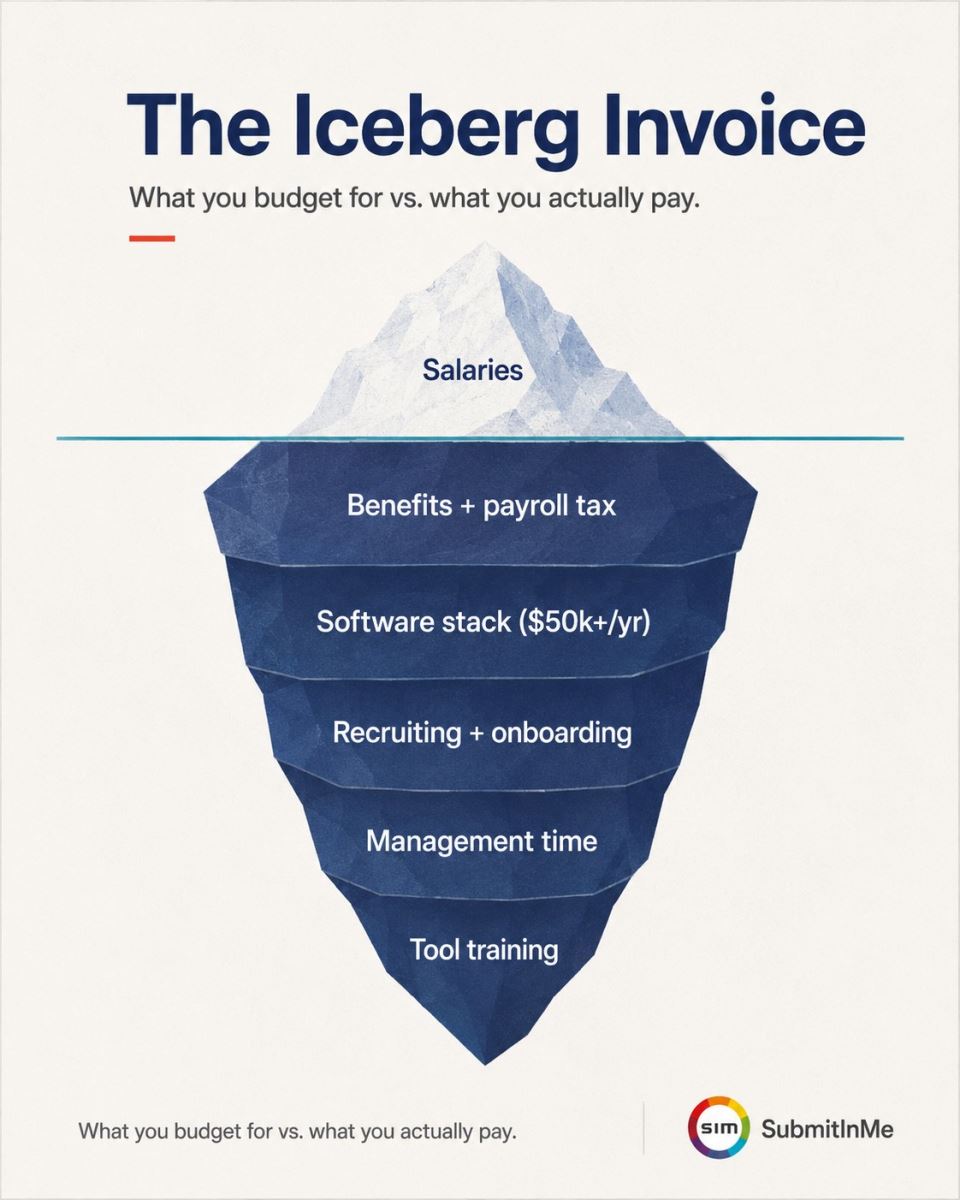
The number you can't see
Opportunity cost is a plain idea wearing an economics term. It's the value of the best thing you gave up to do the thing you chose. Spend a dollar here, you can't spend it there. Spend a year building a team, you don't get the year back.
For an in-house marketing team, the bill comes due in four ways.
First, dead time. The average marketing role takes about fifty days to fill, and a full team can take six to eight months to staff and onboard. That's most of a year where the work limps along while competitors keep shipping. You pay in lost ground before anyone produces a thing, and the meter never stops, salaries going out the door the whole time with little coming back.
Second, single points of failure. A small team means one person owns paid ads, one owns content, one owns the local listings. When someone quits, and people quit, that channel goes dark or lands on a colleague who half-owns it at best.
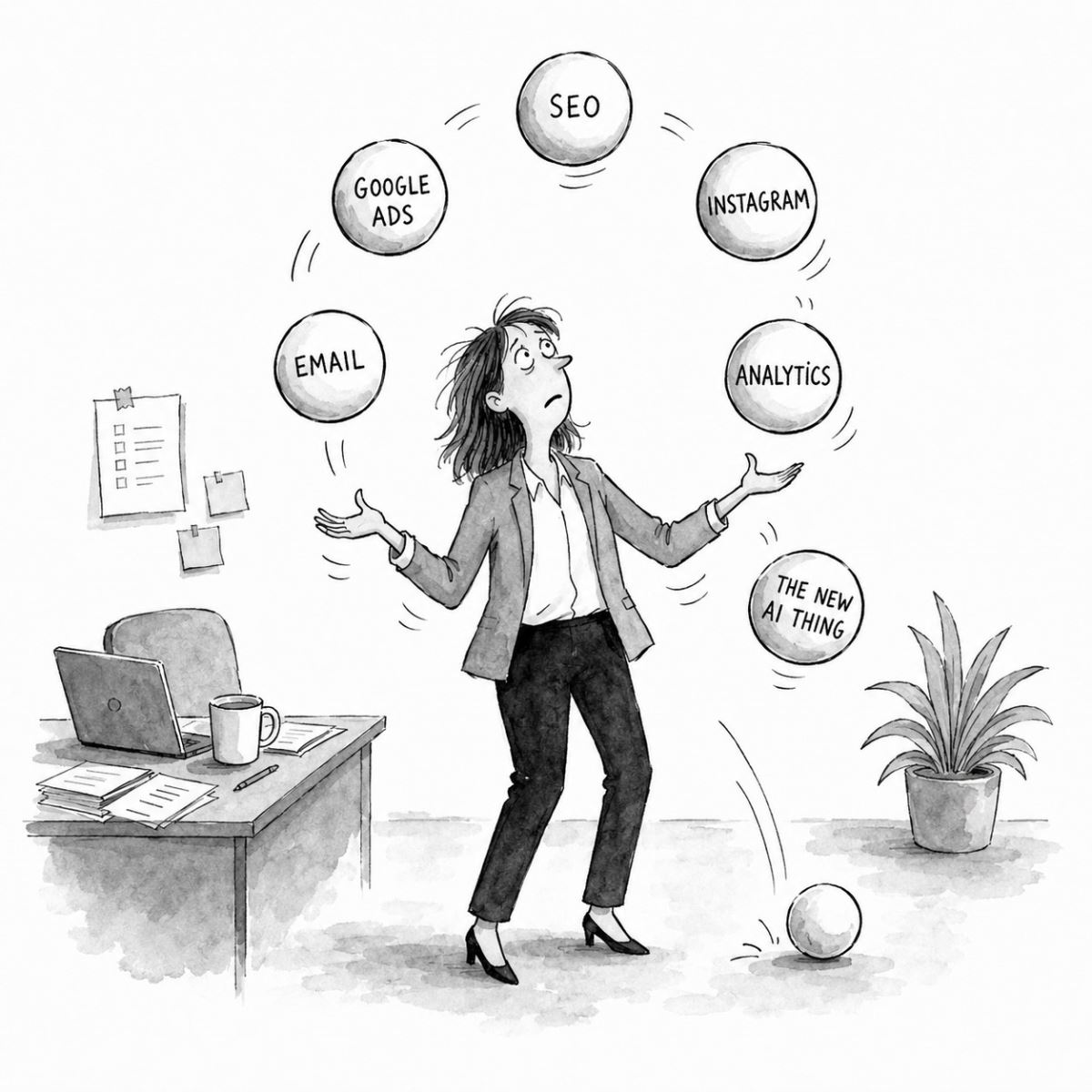
Third, the generalist trap. Modern marketing isn't one job. It's search, paid media, content, local listings, analytics, conversion work, and now answer-engine visibility, each one shifting under your feet every few weeks. Ask one or two people to be expert at all of it and you get competence spread thin, which is a polite way of saying mediocre everywhere.
Fourth, and biggest, your own attention. In a small company the founder's focus is the scarcest resource in the building. Every hour spent refereeing the marketing team is an hour not spent on the product, the customers, the deals only you can close.
Add it up and the picture flips. The salary was the cheap part.
Then the robots showed up
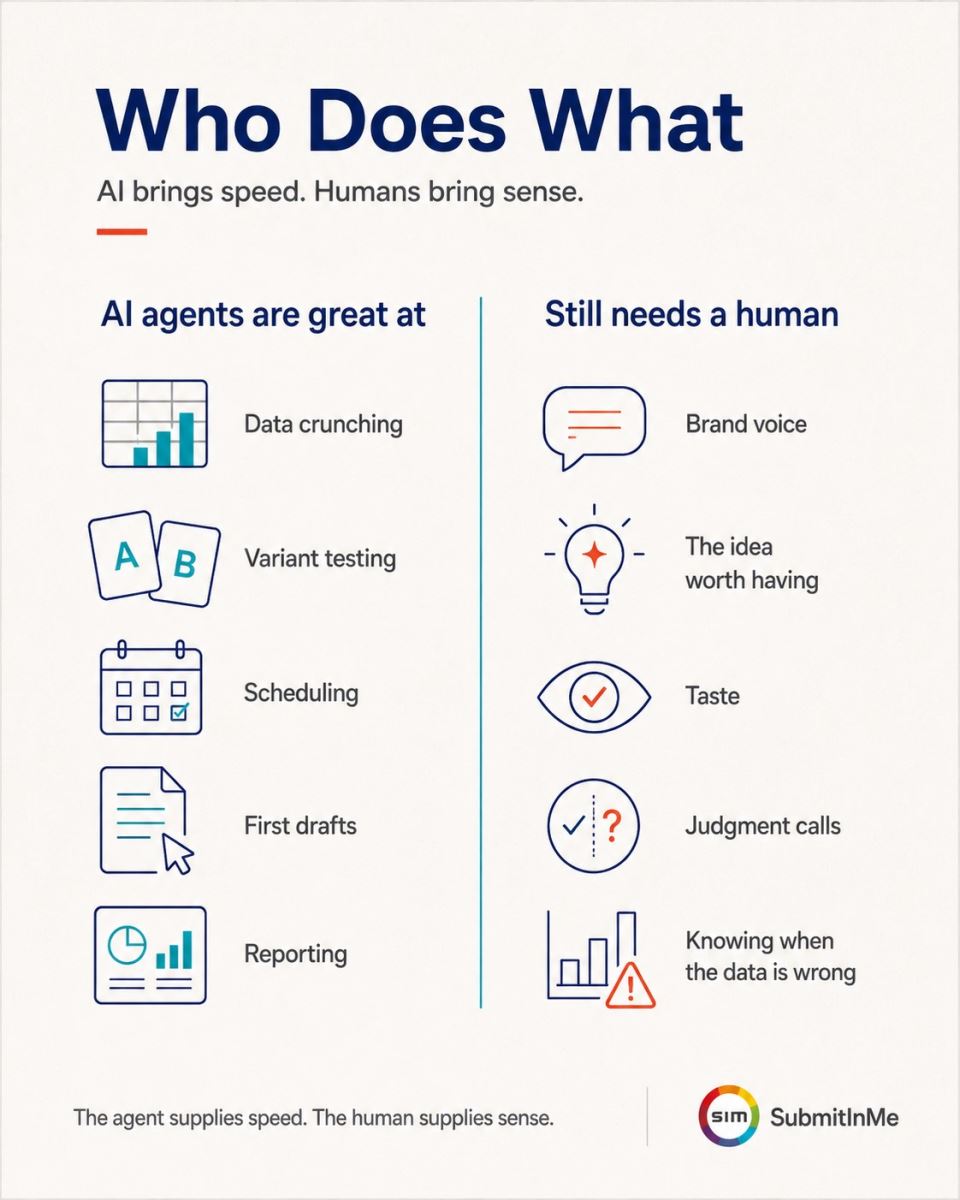
Now the twist everyone's been waiting for. AI can do a lot of this. Agents draft copy, test variants, schedule posts, pull reports, and crunch data faster than any junior hire. Gartner expects AI agents to live inside four in ten business applications by the end of 2026, and most marketers already reach for these tools every day. The efficiency is not hype. A task that used to eat a junior analyst's whole afternoon, turning a month of messy campaign data into a clean report, now takes a well-prompted agent a couple of minutes.
So why not hand the whole problem to the machines and let them run marketing?
Because of where they break. Generative models confidently invent facts and can't reliably tell you when they've done it. They don't reason from first principles, they pattern-match. They miss humor, sarcasm, subtext, the exact raw material that makes a brand worth remembering. An agent can write fifty subject lines in a second. It cannot tell you which one is funny, which one is a touch too clever, which one your particular customer will actually trust. That judgment is human, and it's the whole game.
The model that actually wins
So the real question isn't humans or machines. It's whether you build the hybrid yourself or rent one that already works.
The method has a name: human-in-the-loop. People guide and check the AI, catching the invented number before it reaches a client, rewriting the draft that's technically fine and completely forgettable, deciding what's worth saying in the first place. The agent supplies speed. The human supplies sense. An agent with nobody steering it just makes wrong calls faster.
Building that in-house means paying for all of it at once: the specialists, the AI stack, and the senior oversight to supervise the agents. That's the full team cost, plus a software bill, plus a governance problem you've never had to solve before.
An experienced outside team already runs that control room. The agents are configured. The oversight is built in. You rent the speed and the judgment together, on day one, without the half-year hiring slog or the half-million-dollar payroll. Outsource marketing to a team that pairs AI marketing agents with real human oversight, and the opportunity cost that quietly drains an in-house marketing team mostly disappears.
In-house vs. freelancers vs. an experienced team
|
|
In-house team |
Freelancer patchwork |
Experienced agency (AI + oversight) |
|
Upfront cost |
$450k–$550k/yr and up |
Low, but uncoordinated |
Predictable retainer |
|
Time to results |
6–8 months to staff |
Fast to start, slow to align |
Starts in days |
|
Skill breadth |
Capped by headcount |
Patchy, siloed |
Full stack in one place |
|
Continuity risk |
High (one exit, dark channel) |
High (people churn) |
Low (team-based) |
|
AI tooling |
You buy and learn it |
Inconsistent |
Included and supervised |
|
Creative judgment |
Depends who you hired |
Varies by freelancer |
Senior oversight standard |
Common questions
Isn't in-house always cheaper?
Only if you count salaries and stop there. Add benefits, tools, recruiting, management time, and the months of dead air while you hire, and the math usually favors an outside team.
Won't AI just replace agencies too?
AI replaces tasks, not judgment. The teams that win are the ones running agents under expert supervision, which is the exact thing a solo tool or a stretched in-house hire can't reproduce.
How fast can an outsourced team start?
Days, not months. The specialists and the tooling already exist, so there's no hiring runway to wait out.
Do we lose control of our brand voice?
No. A good team treats your voice as the input that matters most, and a human owns it. The AI drafts toward it. It doesn't get to define it.
What if we want both in-house and outside help?
That's the most common setup now. Keep a lean internal owner for strategy, and hand execution to a team that runs the agents and the oversight for you.
Ready to buy momentum instead of building it?
At SubmitInMe, we've spent since 2002 doing exactly this work: pairing AI-driven execution with senior human judgment so your marketing moves fast without losing the spark that makes people choose you. If a flat growth chart and a heavy payroll line sound familiar, let's find your quickest wins first. Book a strategy call and we'll map the fastest route to measurable growth for your business.