For months, our citation-building process looked almost identical for every business.
A company description was written. A list of target keywords was finalised. Then the same information was submitted across local directories one after another.
Some directories approved listings within hours. Others took days or even weeks. Eventually, live listing URLs arrived, the links were documented, and the process repeated for the next directory.
At first glance, this raises an interesting question.
If Google has spent years fighting duplicate content, spammy links, and manipulative SEO tactics, why does citation building continue to be a trusted local SEO strategy?
It's also a question that many businesses ask when evaluating citation building services. If the same business information appears across multiple directories, what makes local citations valuable rather than problematic?
After all, many businesses use the same company description, the same contact information, and the same website URL across dozens of directories.
Shouldn't that be a problem?
The answer lies in understanding the difference between content created to manipulate search rankings and information created to verify a business.
While Google's Panda, Penguin, Pigeon, and Hummingbird updates rarely dominate SEO conversations today, the principles behind them still help explain why local citations remain valuable in 2026.
Before we revisit those algorithms, it's worth understanding what citation building actually looks like in practice.
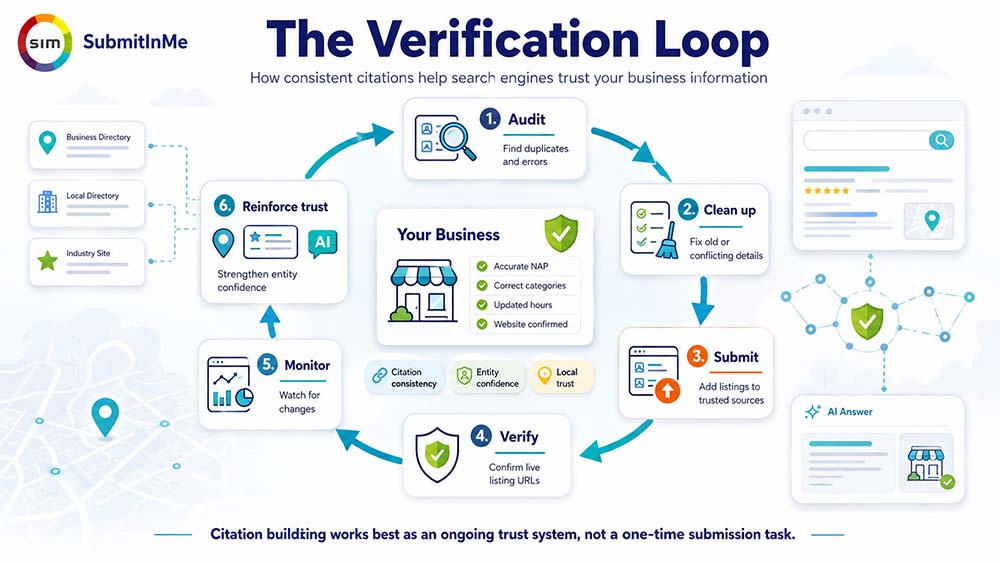
The Citation Workflow Most Local SEOs Know Well
Whether you're a business owner or an SEO professional, the process is usually familiar.
You create a business profile that includes:
-
Business name
-
Address
-
Phone number
-
Website URL
-
Categories
-
Company description
-
Service information
That information is then submitted to local directories, industry-specific platforms, mapping services, and business listing websites.
The goal isn't simply to create backlinks.
The goal is to establish consistency.
When search engines repeatedly encounter the same business information across trusted sources, they gain confidence that the business is legitimate, active, and operating where it claims to operate.
This is where many discussions about duplicate content miss the mark.
A business listing is not the same thing as a blog post, service page, or article. Citations exist primarily to validate business information rather than provide unique editorial content.
This workflow is common among both in-house marketing teams and professional citation building services. While the tools and processes may vary, the goal remains the same: creating consistent business information across trusted local directories and business listings.
Book a Free Strategy Call
Does Google Actually Hate Duplicate Content?
One of the biggest misconceptions in SEO is that Google automatically penalises duplicate content.
In reality, Google is usually trying to identify the most useful version of similar content rather than punish websites simply because information appears in multiple places.
Think about local directories for a moment.
If your business name, address, phone number, and company description appear on multiple trusted platforms, that's often expected behaviour. Google understands that business information naturally gets distributed across directories, maps, review websites, and industry platforms.
The bigger concern is not duplication.
The bigger concern is quality.
If a directory contains thin, outdated, inaccurate, or low-value information, its usefulness decreases. If a directory exists solely to generate links without helping users, its value becomes questionable.
This distinction helps explain why local citations can still work even when similar business descriptions appear across multiple platforms.
That said, many local SEO professionals still customise descriptions for their most important directory profiles. While identical descriptions are unlikely to trigger penalties, unique business summaries can provide additional context and help important listings stand out.
What Google's Classic Algorithms Can Still Teach Us
We don't need a history lesson on every major Google update, but these algorithms still provide useful context.
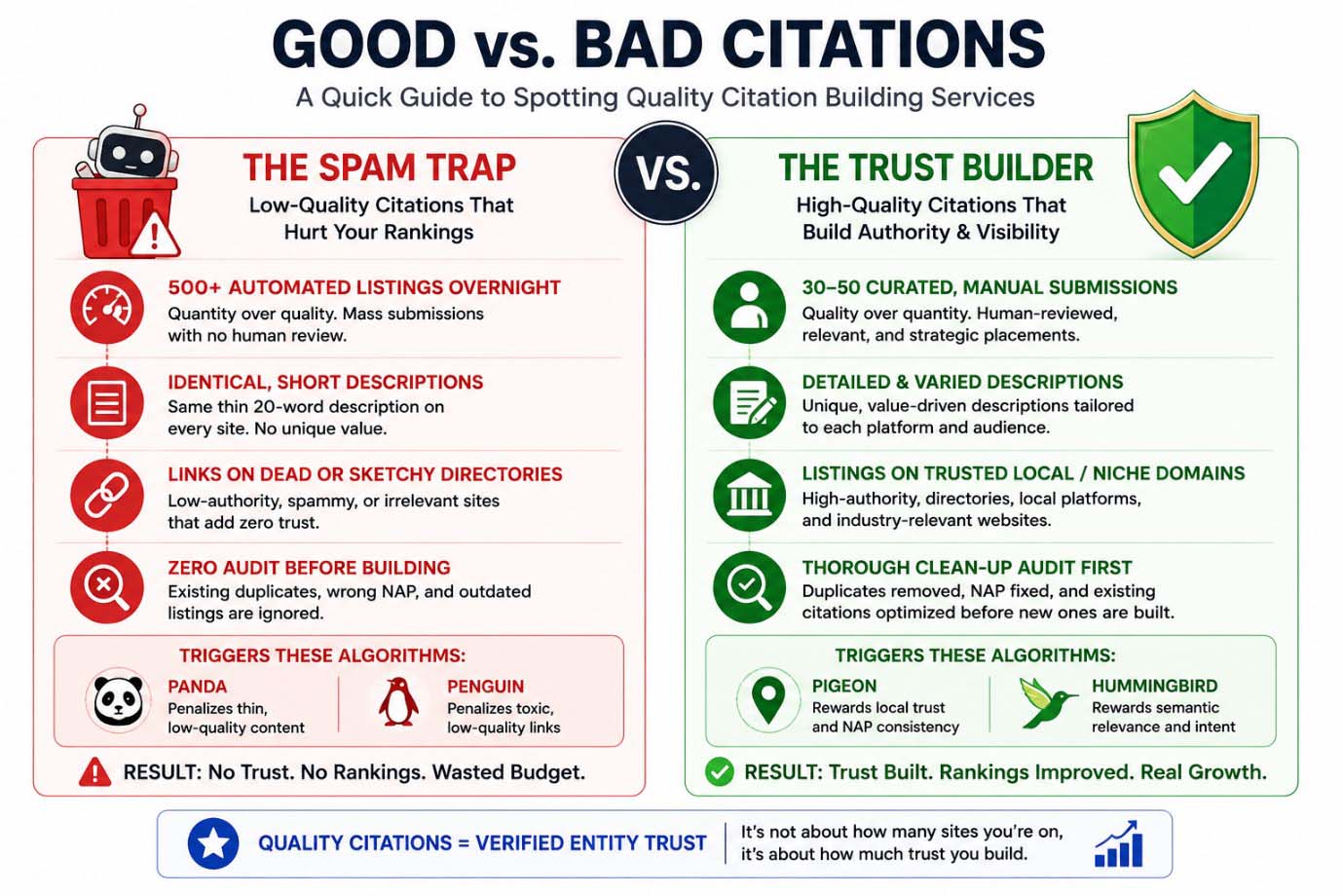
Panda: Quality Still Matters
Panda focused on low-quality and thin content.
When applied to citations, the lesson is simple: a complete, accurate business profile is more valuable than an empty listing filled with generic information.
Using the same company description across trusted directories is rarely the issue. Publishing weak, incomplete, or low-value listings is a much bigger concern.
Penguin: Not All Citation Links Are Equal
Every citation usually includes a link back to your website.
That's where Penguin becomes relevant.
Google has always cared more about link quality than link quantity. A citation from a respected local directory is very different from hundreds of links generated through questionable directory networks.
Quality directories contribute trust. Low-quality directories contribute noise.
This is why reputable citation building services focus on directory quality rather than submission volume. A handful of trusted listings often provide more value than hundreds of low-quality directory links.
Pigeon: The Algorithm Most Relevant to Citations
If one Google update deserves special attention in this conversation, it's Pigeon.
Local search relies heavily on business consistency.
Accurate citations help Google verify business details across the web, making them an important component of local SEO. Consistent information reinforces trust, while conflicting information can create uncertainty.
Hummingbird: Understanding Search Intent
Modern searches are increasingly conversational.
People search for:
-
emergency plumber near me
-
dentist open now
-
seo agency near me
-
best pizza delivery nearby
Complete business listings help search engines connect businesses with these natural language searches by providing clear context about services, locations, and relevance.
The Real Reason Citations Still Matter in 2026
The biggest reason citations continue to work has little to do with duplicate content.
Today, search engines are increasingly focused on entities.
An entity is a real-world thing that can be identified and understood. Your business is an entity.
When Google repeatedly sees the same business name, address, phone number, website, categories, and service information across trusted sources, it gains confidence that the entity is real.
This is why citations remain valuable.
They're not simply links.
They're validation signals.
The same principle extends beyond traditional search. AI-powered search experiences, AI Overviews, and large language models rely on trusted sources to understand businesses, locations, and services. Consistent business information across authoritative platforms helps reinforce that trust.
As AI-powered search evolves, citations serve a purpose beyond traditional rankings. AI systems increasingly rely on structured business information from trusted directories to verify facts such as operating hours, locations, services, and contact details. Consistent citations help ensure that search engines and AI assistants understand and represent a business accurately.
In many ways, modern citation building is less about rankings and more about credibility.
Get a Free NAP Audit
What Quality Citation Building Looks Like Today
Businesses that want to manage citations effectively often use dedicated platforms to audit listings, identify inconsistencies, and monitor local presence.
Some commonly used platforms include:
-
BrightLocal
-
Whitespark
-
Semrush Local
While these tools can streamline the process, they don't replace quality control. Many citation building services use platforms like BrightLocal, Whitespark, and Semrush Local to identify duplicate listings, monitor citation accuracy, track business information, and maintain consistency across important directories. Business information should still be reviewed regularly to ensure accuracy and consistency.
Red Flags to Watch for When Hiring a Citation Building Service
Not every citation service follows sustainable local SEO practices.
Watch for these warning signs:
Promises of Hundreds or Thousands of Citations Overnight
More listings don't automatically mean better results. Quality almost always beats quantity.
Guaranteed Rankings
No legitimate local SEO provider can guarantee rankings. Citations support local visibility, but many other factors influence performance.
No Reporting or Live Listing URLs
A reputable provider should be able to show exactly where your business was submitted and provide access to live listings whenever possible.
Extremely Cheap Pricing
If a service promises hundreds of submissions for almost nothing, automation is usually doing most of the work.
No Citation Audit
Before building new citations, existing listings should be reviewed for duplicates, outdated information, and inconsistencies.
Final Thoughts
If Google truly hated every form of duplicate information, local citations wouldn't exist.
The reason citation building continues to work is because citations serve a different purpose than traditional content.
They help search engines verify business information, reinforce trust, establish local relevance, and confirm that a business is a legitimate entity.
Panda reminded us that quality matters.
Penguin reminded us that link quality matters.
Pigeon reinforced the importance of local trust.
Hummingbird improved Google's understanding of intent.
While these algorithm names may feel like relics from another era, the principles behind them still help explain why local citations remain an important part of local SEO today.
In 2026, successful citation building is less about submitting a business to as many directories as possible and more about building trust. Consistent business information, trusted listings, and strong entity signals help search engines and AI systems understand who you are, where you operate, and why your business deserves visibility.
Talk to an Expert