I've noticed a pattern in local SEO lately that I don't think we can overlook anymore.
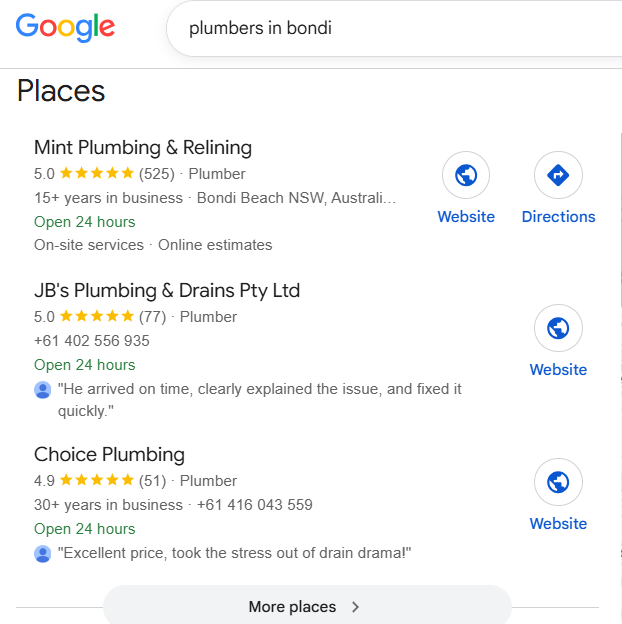
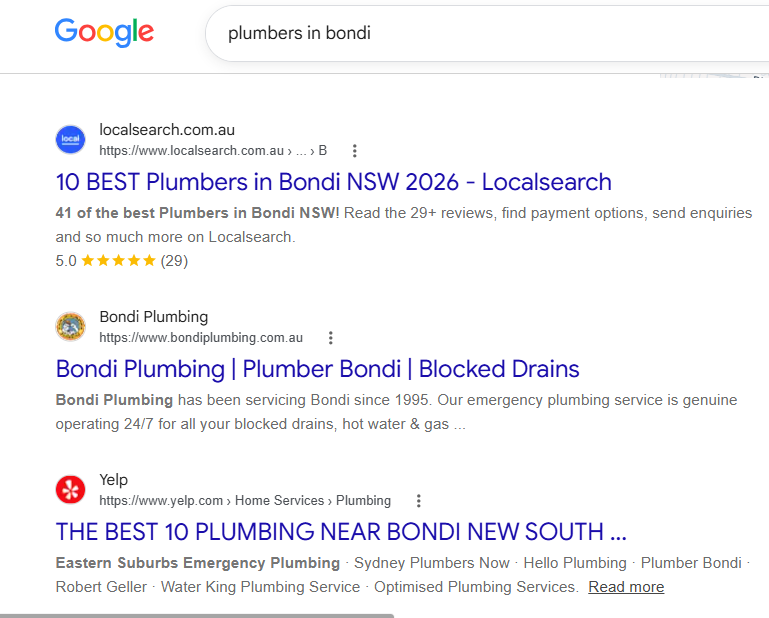
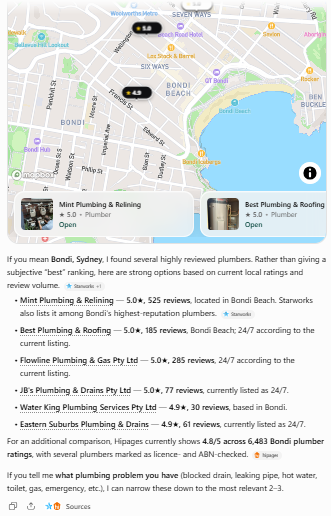
I recently searched "plumbers in Bondi" on Google and asked ChatGPT to find me the plumbers in Bondi. One of the three businesses in Google's local pack didn't appear in ChatGPT's answer. Bondi Plumbing, the second organic result, wasn't mentioned either. ChatGPT recommended four other plumbers instead. It was one search on one day, so I wouldn't call it proof, but it's worth paying attention to.
Google Local Pack
Organic Result
ChatGPT Lists and Sources
That made me question what we’re really optimizing for.
AI citations play a significant role in the trust signals LLMs rely on, and many businesses are getting caught out.
By AI citations, I mean the directories, websites, reviews, profiles, and third-party mentions that AI systems draw on to understand a business before recommending it.
Businesses are still focused on rankings, while AI tools appear to rely on a broader set of signals to determine which companies seem relevant, credible, and worth mentioning.
So, What Changed with Citations?
For years, local SEO citations were fairly straightforward.
We ensured the business name, address, phone number, website, category, and other details were accurate across directories. We fixed inconsistencies, removed outdated listings, and built new citations on relevant local and industry platforms.
I still think that process is important. What has changed is how much context these sources can now provide.
An LLM can pick up services, location, reviews, business description, expertise, and what other websites say about a business. When several reliable sources keep confirming similar information, an AI system can understand the business more easily.
In my Bondi search, ChatGPT ranked plumbers on ratings and review volume, and it cited Starworks and Hipages as sources. Both are third-party sites, not the plumbers' own websites.
That's the kind of profile and review presence citation building has always covered.
Perhaps this is where citation building needs to evolve.
Consistency is still part of the job, while context is becoming equally difficult to ignore.
Google Rankings Aren’t Telling Us the Full Story
BrightLocal recently analyzed more than 200,000 localized AI searches and 1.9 million citations. Google Maps surfaced the tracked businesses in 66% of searches, while the AI platforms studied mentioned them in roughly 32% to 38%.
My quick Bondi check pointed the same way, though it was only one search. Strong Google visibility doesn't automatically translate into strong AI visibility.
It may also explain why businesses outside the Maps pack can still appear in ChatGPT recommendations. You only tested ChatGPT. The LLM may be finding enough supporting information elsewhere. So, if we only track Maps rankings, we may be missing part of a search journey that's already happening.
We are already seeing this shift inside Google itself. Features such as Ask Maps are making local discovery more conversational, where intent, reviews, photos, location data, and business information can all shape the recommendation a user receives.
For a closer look at this change, read our breakdown of what Google Ask Maps could mean for local business.
Local Citation Building Has to Change
This is where I think we need to be careful.
SEO has a habit of finding a new signal and turning it into a numbers game. We did it with backlinks and directory listings, and I can already see the same thing happening with AI citations.
The assumption is that if citations influence AI visibility, more of them must be better.
I'm not convinced. Chasing volume without considering relevance, credibility, or context adds very little.
A strong industry directory, local publication, review platform, or relevant business profile may give an LLM far more useful information than dozens of generic listings repeating the same details.
This does not make traditional citation consistency irrelevant either. Google itself says Business Profile information can be drawn from a business website, third-party data, user contributions such as reviews, and other sources. Local search has already relied on information being confirmed across more than one place.
That same principle helps explain why local citations still matter even when the information is repeated.
What's changing is the role citations play. They no longer just confirm basic business details. They also give AI systems context on what a business does, where it operates, and how it's described across the web.
Your Website Is Part of the Citation Conversation Too
I wouldn't push everything toward third-party citations and ignore the website. With so much discussion around Reddit, directories, reviews, and third-party mentions, it is easy to assume that GEO means getting mentioned everywhere except your own site.
Current data suggests otherwise.
In BrightLocal’s study, business websites made up 42% of nearly two million citations analyzed, and 93% of the unique domains used as sources were business websites.
That puts the website right back in the middle of the conversation.
Service pages, location pages, About page, FAQs, business details, and locally relevant content all help LLMs understand what a business does. Neither third-party citations nor the website can carry the entire strategy alone.
The strongest position comes when both reinforce the same information.
Where GEO Fits into Local SEO
Local SEO already gives us most of the foundation, Google Business Profile, reviews, citations, local pages, backlinks, and the website itself.
GEO comes in when we start asking how LLMs are reading all of that.
Can ChatGPT clearly understand what the business does? Which sources is Gemini relying on? Why does one competitor keep getting mentioned while another barely appears?
That is where Generative Engine Optimization services become useful.
For local businesses, GEO can show which sources help LLMs understand the brand, and where the information is weak, inconsistent, or missing. It’s the same work local SEO has always done, aimed at a new kind of reader. Hence, I see GEO as an extension of local SEO rather than an entirely separate discipline.
Where Does Local SEO Go from Here?
I'm not suggesting businesses abandon traditional local SEO or rebuild everything around ChatGPT or Gemini. Keep the foundation, but broaden the audit.
Alongside asking where a business ranks, we should ask which sources confirm it, what those sources say, whether LLMs repeatedly recognize the company, and why certain competitors keep appearing in AI recommendations.
This is why AI citations need to be part of local SEO, especially as search behavior spreads across Google Maps, AI Overviews, AI Mode, ChatGPT, Gemini, and whatever comes next.
We may not have a perfect label for their role yet, but ignoring AI citations because they don't fit the old ranking-factor checklist would be a bigger mistake.
What I’d Do Next
If I were reviewing a local business today, I wouldn’t stop at rankings. I'd start with a check like the plumber search above.
I’d check whether the business appears in ChatGPT and Gemini, which sources those answers use, whether the website clearly explains its services and locations, and how consistently the same information appears across directories, reviews, and third-party sites.
I'd also compare all of that against the competitors LLMs keep mentioning.
That, to me, is where local SEO auditing is heading. Rankings are crucial, but they are becoming only one part of the visibility picture. Businesses increasingly need to understand not just where they rank, but how clearly and consistently they are represented across the sources that both search engines and AI systems can access.
What This Looks Like in Practice
We've already seen this play out with one of our clients. A Sydney dental practice with strong experience and an established local presence was barely showing up in AI-generated answers.
Once we improved their business information, content, and supporting signals, their AI visibility increased by 300%, alongside a 25% increase in patients.
That is the bigger point here.
AI visibility is not replacing local SEO. It adds another layer, and the foundation remains the same. I would make sure those foundations are reflected consistently across websites, profiles, reviews, directories, and other sources AI systems use to understand the business.
Want to See How Your Business Appears in AI Search?
To understand how your business is represented across local and AI search, start with the information AI systems can actually find about you. If you’re stuck in the middle or not sure how it works, we can audit your local citations, identify where your business information is weak or inconsistent, and highlight opportunities to improve both local and AI visibility.
Get a local citation audit from our team to find out what’s missing.