I've been handling clients recently, and one of the most niche and posh industries I've come across is home organisers. I remember watching the early 2000s movies with characters playing organisers and joking about nicking their customers’ clothes. That got me thinking: professional organisers are someone you trust, and it's not just like getting a $18 mesh top you see on social media. What medium does one use to choose a professional organiser? Can you find the best organiser just by Googling them or scrolling through Instagram? What if I say AI is the best platform to find your professional organiser? All roads lead to AI! No, I am kidding. I’ve got evidence to back up my claim.
Authority over Keywords
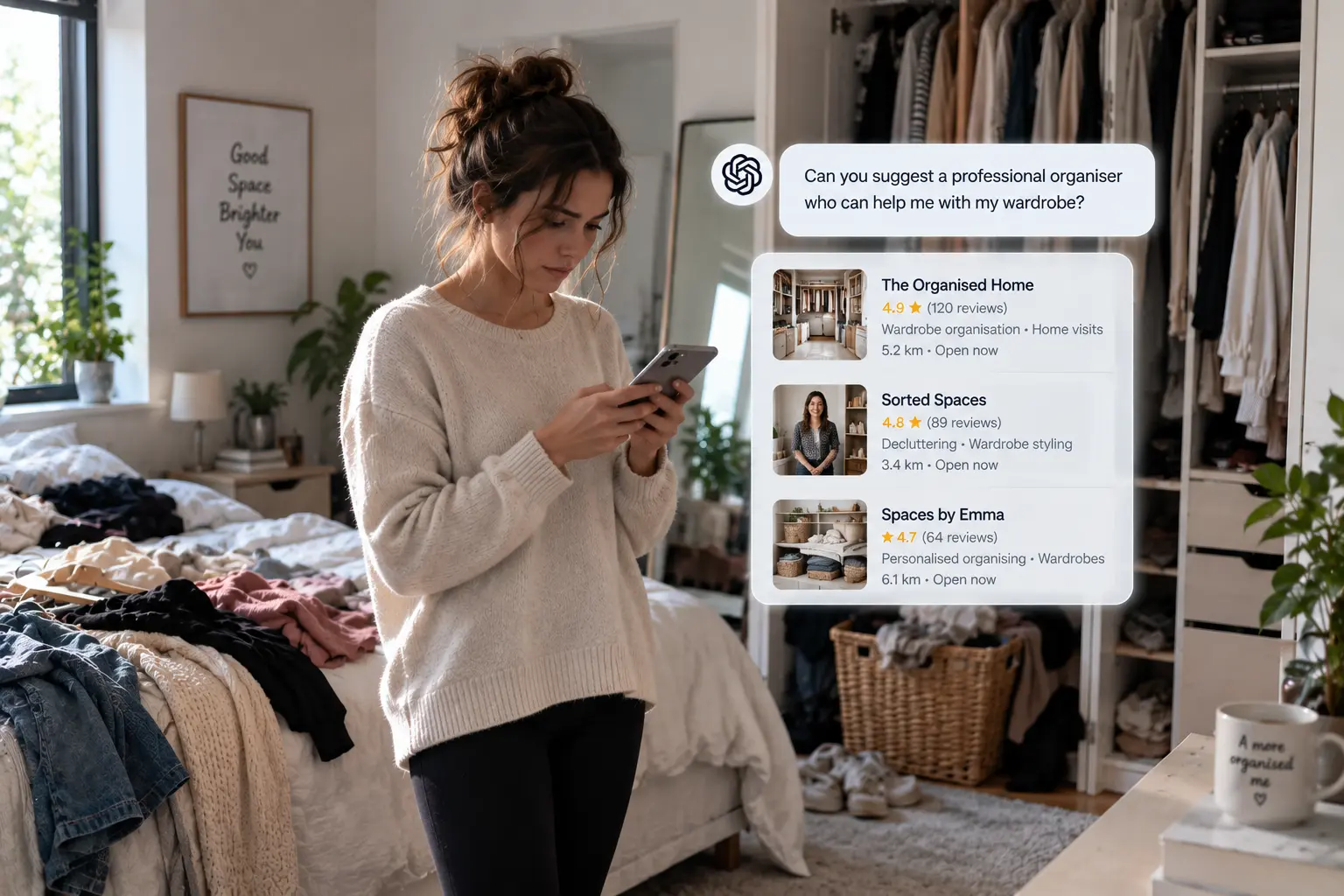
Search Engine results are based on keyword density, backlinks, schema markup, etc. But search engines don't evaluate a brand’s authority when ranking websites. Whereas AI platforms evaluate a website based on how authoritative and trustworthy it is. It uses E-E-A-T (Experience, Expertise, Authoritativeness, and Trustworthiness). Hence, you are most likely to find the right home organiser by asking an AI, “Hey, I want a professional organiser who can help me with my wardrobe”, or “I am running out of time; can you suggest the best organiser?” Therefore, you don’t get answers to your prompt; rather, you get a suggestion to choose the most established, renowned, and safe organiser.
AI Cross References
Moreover, AI uses the brand’s online reputation by analysing its reviews and ratings on online directories like Google Business Profile, Yelp, Houzz, Thumbtack, BBB (Better Business Bureau), Nextdoor, etc. Traditionally, when choosing an organiser, you might search for "Home organisers Austin," see these (no organiser) ranked for your query, then open tabs like Instagram, Facebook, and GBP to review places. BrightLocal found that 74% of consumers check reviews before choosing a business. But you don't have to open 10 tabs to choose an organiser, because AI checks all of these before showing you the results.

Requirement-Specific Answers
Imagine you want a professional organiser for one specific job, like cleaning your wardrobe. You have OCD, and you want your place arranged accordingly; you can't ask this to a search engine. For instance, the average Google search is just 3-4 words, barely room for more than a keyword. AI prompts, by comparison, average around 23 words when people ask full questions rather than typing search terms, giving enough space to actually explain a specific situation instead of just a few keywords. This comes down to how large language models are actually built: they run on transformer architecture with something called self-attention; basically, the model reads every word in your sentence against every other word at the same time, so it gets the full picture of what you mean, not just matching keywords the way Google does. This saves you a lot of time and gets you the organiser you actually want; most importantly, the organiser who is best at that particular task, rather than vague responses.
Are you an Organiser? Flip the Script
So that's if you want an organiser. But what if you are the organiser? You should be well aware that your customers are using AI. There will be people out there saying, "just ask AI for organising solutions," but come on, you know the job is hectic, and in a world where people are burning the candle at both ends, they're not going to ask, "where does my red dress go?" Rather, they'll ask, "Who can put my red dress in the right place?"
Now, the real question is: how do you appear on AI even though you're not ranking in search engines? It's still a war; you've got to outrank your competitors to boost your AI visibility and prove you can actually handle the specific task they need. This shift away from traditional Search Engine Optimization is called GEO, Generative Engine Optimization, and that's exactly what helps you rank on AI platforms.
GEO for Professional Organisers
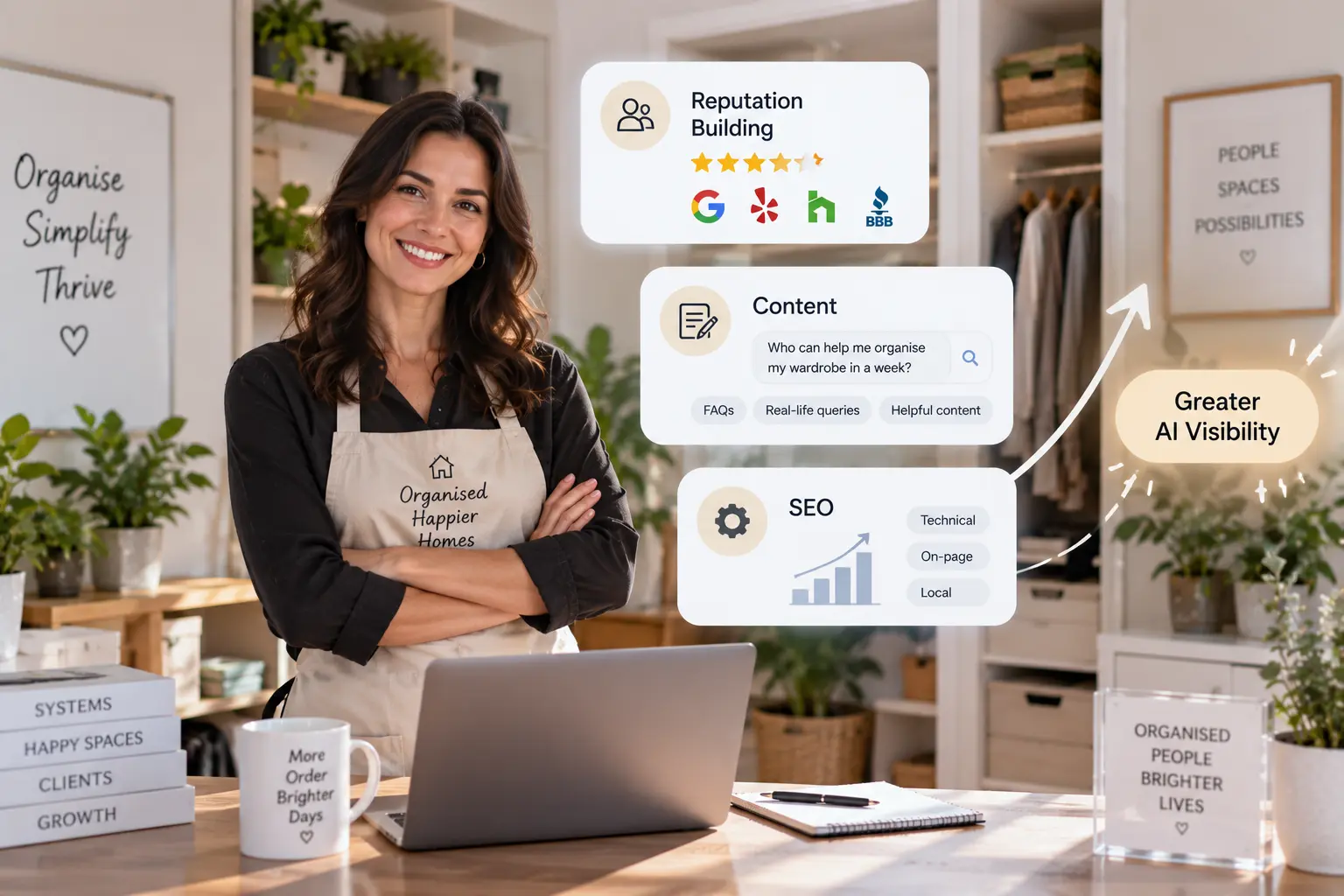
Generative Engine Optimization helps your website appear in AI for user-specific queries. Many factors contribute to boosting your AI visibility, but I’ve listed the top three points that organisers should focus on to start their GEO journey
Reputation Building
AI cross-references your business’s reviews across trusted platforms like Google Business Profile, Houzz, BBB, etc. Getting positive and genuine reviews on these platforms can help build your online credibility, thereby improving AI visibility.
Content
Prompts from users are not straightforward, and they are most likely to use long-tailed queries like “who can help me get my wardrobe arranged in a week”. Hence, your website queries should be optimized using fan-out queries, FAQs and real-life statistics.
SEO
A very common misconception about GEO is that SEO is no longer necessary. But you should remember that SEO is not dead; rather, it is the foundation of GEO. So, your website’s SEO factors should be optimized to boost your AI visibility.
Are you an organiser struggling to get leads? Don’t worry! SubmitINme’s dedicated GEO team audits your website and finds the best strategy to boost your AI presence. Contact our team and get your brand recommended by AI.