A customer clicks a Google Ad today visits the website and signs up for a free. The customer does not buy away. A days later the customer returns ask for a demo and eventually becomes a paying customer.
For businesses this path is typical. A person rarely buys after one interaction especially when the product or service needs research and comparison.
Advertisers often focus their Google Ads campaigns on a final conversion, such as a purchase or qualified lead. Other useful interactions along the way may not be fully used by Smart Bidding.
Google is addressing this with Search Journey Awareness, an addition to Smart Bidding that helps Google AI understand more stages of a customer journey and use those conversion signals to make better bidding predictions.
What Is Search Journey Awareness?
Search Journey Awareness is an addition to Google Ads Smart Bidding. It allows Google bidding models to learn from conversion actions across the customer journey from actions that campaigns do not directly optimize for.
Previously advertisers could track different conversion actions, such as newsletter sign-ups, demo requests, purchases and qualified leads. Their bidding strategy generally focused on the primary conversion goals chosen for optimization.
With Search Journey Awareness Google AI can also use secondary conversion signals to understand how customers move from their first interaction to the final conversion.
This is especially useful for businesses with sales cycles, where customers need multiple interactions before making a purchase.
How Does Search Journey Awareness Work?
Let us take an example of a clinic that runs Google Search Ads to bring in patients.
A potential patient searches for "dentist near me". Clicks, on the clinic’s ad. The patient visits the website, explores treatments and checks the clinic’s location and reviews. The patient may not book an appointment immediately.
Imagine the dental clinic running Google Ads campaign for people who have book appointments.
With Search Journey Awareness Smart Bidding the system can look at signals, from steps like when someone asks about treatments or interacts with the website. This helps the system understand how patients move through the process while still focusing on getting people to book appointments. This gives Google AI information about the actions people take before becoming actual patients.
Which Campaigns Are Eligible?
Search Journey Awareness is available as a feature of Smart Bidding. According to Google’s documentation it applies to campaigns using the following bidding strategies
- Target CPA
- Target ROAS
- Maximize Conversions
- Maximize Conversion Value
It applies to Search campaigns, including AI Max and to Search inventory on Performance Max using Smart Bidding. There is no opt‑in process or on/off switch. The feature is automatically activated when the account meets the eligibility and conversion tracking requirements.
How to Prepare Your Conversion Tracking for Search Journey Awareness
Although Google activates this feature automatically advertisers should review their conversion tracking setup to get the value from it.
1. Track Every Important Conversion Stage
Do not track the final purchase or completed lead.
Consider actions that show customer interest, such as
- Free registrations
- Newsletter sign-ups
- Demo requests
- Contact form submissions
- Call or Message Clicks
- Completed purchases
I notice that when you track these actions Google AI learns more, about how customers interact with your business.
2. Categorize Your Conversion Goals Correctly
Each conversion action must be placed under the right conversion goal.
- Open your Google Ads account.
- Go to Goals and navigate to summary section
- Find the relevant conversion action.
- Select the three-dot menu next to it.
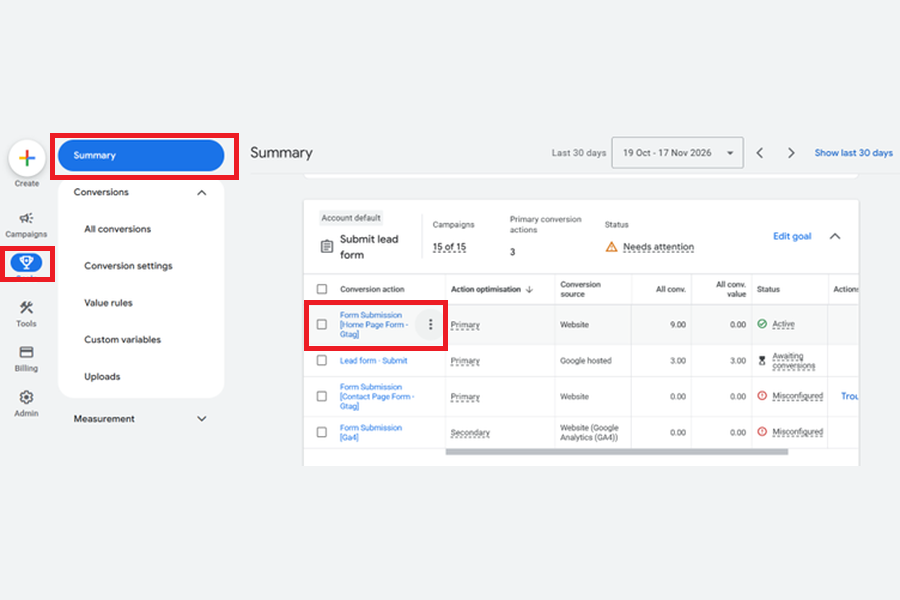
- Choose Change to another goal.
- Select the appropriate goal category.
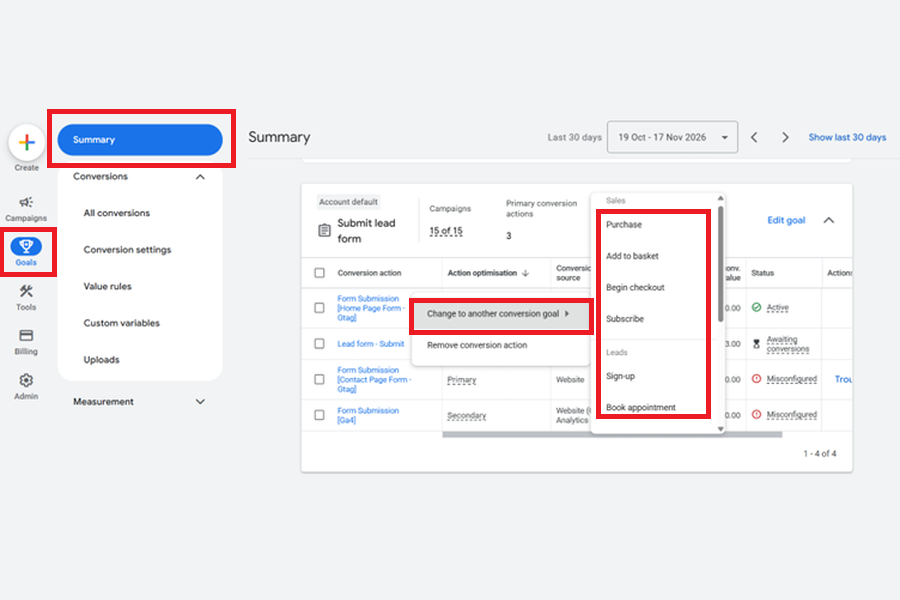
Google also notes that the Default category is not supported for this feature.
3. Keep Your Final Business Goal as Primary
More conversion data does not mean you should optimize your campaigns for every action. Think about what matters to your business.
If your goal is to generate paying customers keep the purchase as your primary conversion action.
Earlier interactions, such, as free registrations or demo requests can remain secondary conversion actions. This allows Google AI to learn from those signals without changing the goal your campaign is optimizing toward.
4. Send Conversion Data Regularly
For businesses that track leads offline the customer journey does not end when a form is submitted. A lead may become qualified move into the sales pipeline and eventually become a customer. Conversion data remains important in this journey.
Make sure that these conversion updates are sent to Google Ads soon as the data becomes available. Regular conversion data helps Smart Bidding learn from customer activity. Google recommends that conversion delays should ideally be, then seven days.
5. Don't Remove Existing Conversion Signals
When you restructure conversion goals avoid removing conversion actions unless you have reviewed their importance. Google recommends keeping existing conversion signals so that Smart Bidding can keep learning from the customer journey data.
Will Adding Secondary Conversions Affect Campaign Performance?
This is a question for advertisers who worry about changing their existing campaign setup.
According to Google adding secondary conversion actions will not automatically hurt campaign performance. Smart Bidding is designed to identify which secondary conversion signals are useful for improving its predictions. Smart Bidding can ignore signals that it considers unhelpful.
However, advertisers should be careful when changing conversion actions or goals used for bidding optimization. These changes may cause short‑term performance fluctuations. Google also clarifies that changing secondary conversion actions that are not used for bid optimization will not affect bidding performance.
How Does Search Journey Awareness Affect Conversion Reporting?
There is one reporting difference advertisers should understand when adding secondary conversion actions.
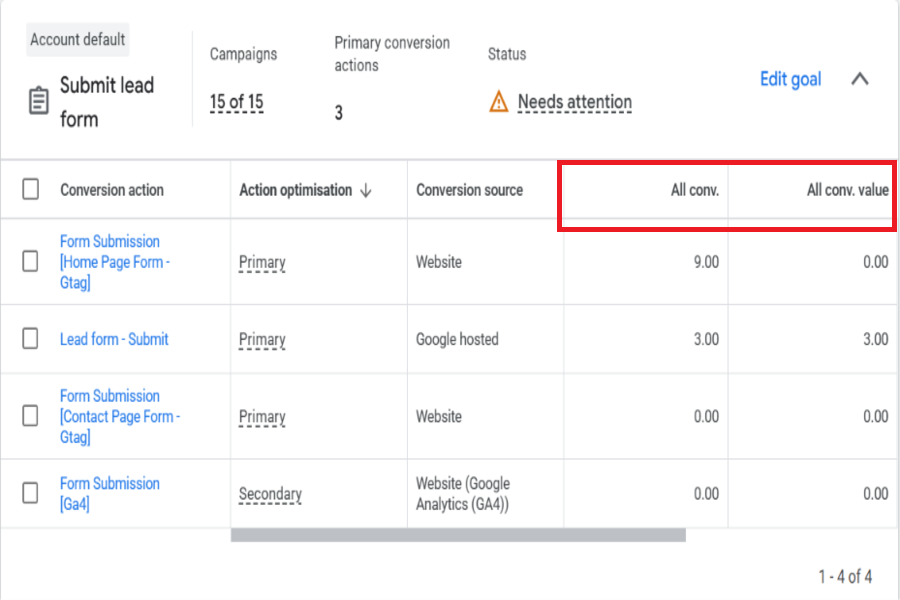
Google Ads uses two reporting columns
- Conversions: Includes primary conversion actions within the goals used for bidding.
- All Conversions: Includes both primary and secondary conversion actions.
For example, if a campaign records 10 purchases and 30 free registrations, as conversion actions the Conversions column can keep showing 10 while All Conversions can include both types of activity.
With Search Journey Awareness, Google is giving Smart Bidding opportunities to learn from relevant conversion signals across these different stages.
Need help improving your Google Ads performance?
Chat on WhatsApp +91 94423 64284