SEO still plays an important role in helping your website get discovered. But as search expands beyond traditional text queries, there are now more ways to think about how that visibility happens.
You can point your camera at something, upload a photo, circle something on your screen, or search an image directly from Chrome. Google can then try to understand what you're looking at and find information around it. Now Google Search Console is starting to show us what happens on the other side of those searches.
On September 24, Google introduced multimodal search performance reporting in Google Search Console, adding a new filter to its Performance reports. The reporting covers visual searches through Google Lens, Circle to Search on Android, image uploads to Google Search, and Chrome's “Search this image” feature.
Google says the reporting will start showing metrics for sites that receive traffic from these multimodal searches, with the rollout happening globally.
As someone who works in SEO, I find this update interesting for one simple reason: we finally get another way to look at search visibility.
Search Console is giving us a look at visual search
Until now, it wasn't particularly easy to understand how much visibility a website was getting from multimodal searches.
The new multimodal search filter gives us a way to separate that activity from other search data.
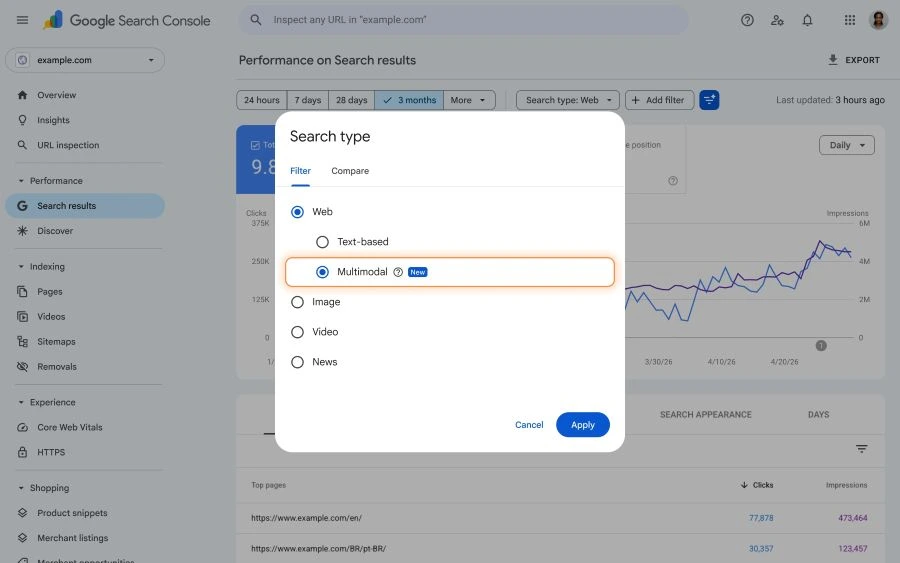
Google says the data is available in the Search results Performance report, and multimodal data is also being added to the report for Generative AI features. The data can be filtered and exported, which should make it easier to dig into the numbers outside Search Console too. That makes this more useful than simply being another new filter in the interface. It allows us to analyze the website’s performance based on an image search.
What does a search look like when there are no words?
For example, someone is searching for,
“Black running shoes with white sole”, or they could simply take a picture of the shoes and use Google Lens or Circle to Search.
Same basic intention. Very different way of getting there. In situations like these, an image can communicate far more than someone can describe in a search box. This change gives visual search a bigger role in SEO.
An image isn't just decoration anymore
I've never really liked the idea of treating images as something we add to a page simply because the page "needs an image."
A useful image can explain something. It can give context. Sometimes it can communicate the thing we're trying to explain much faster than a paragraph can.
And now there's another possibility. That image could become part of the discovery path that eventually takes someone to the webpage.
Of course, that doesn't mean uploading more images will suddenly bring more traffic. The image still needs to make sense for the page and provide something useful. But for ecommerce websites, publishers, travel sites, recipe websites, and other businesses where visual content matters, this is worth paying attention to.
We now have another question to ask
Instead of only looking at overall impressions and clicks, we can start asking:
Are my pages appearing in visual searches?
Which pages are getting multimodal impressions?
Is a particular type of content getting more visibility through image-based discovery? Those are slightly different questions from the usual keyword and ranking analysis. And having the data means we can at least start looking for patterns instead of guessing. There's one thing I wouldn't overlook when looking at this data. A multimodal search doesn't necessarily come with a traditional text query. If someone uploads an image or searches visually, there may not be a conventional keyword for Search Console to show you. So don't expect a neat list of keywords telling you exactly what someone searched when they found your page through a visual search. The useful information here is more about the type of search activity and the pages receiving that visibility. That's an important difference when you're interpreting the report.