Google's September 2026 Spam Update began rolling out and applies globally across all languages. The update is focused on improving how Google identifies and handles spam and manipulative practices that can affect Search rankings
The update arrives at a time when AI can produce thousands of pages, images, videos, business descriptions, listings, and other digital assets in a very short time. This has increased attention around synthetic content, AI-generated spam, scaled content abuse, and coordinated networks.
At almost the same time, Google Research published a paper describing SAFE – Scaled Abuse Forensics Examiner. A multi-agent system designed to investigate large-scale synthetic abuse. The timing has led to considerable discussion in the SEO community about whether the research reflects the direction of Google's broader anti-abuse systems.
What We Know for Sure About the September 2026 Spam Update
Google has described the September 2026 update as a spam update. But Google hasn't announced that this specific update is directed at a particular kind of spam, like AI-generated content, programmatic SEO, expired domains, or link spam. The reason this is important is that a change in ranking is not always a sign that a website is being penalized for using AI.
Google already has a Search spam policy which details the types of behavior that Google considers spam. These involve generating huge quantities of poor-quality text content, keyword stuffing, link spam, scraping, cloaking, and more, all targeted primarily at altering the results in Search.
Google has automated systems that identify spam and sometimes manual review as well. In the event of a site violating Google's spam policies, its pages may become less visible in Search or, in extreme cases, they may disappear from Google's search results.
The Synthetic Gap: Why AI Spam Is Becoming Harder to Detect
Most standard spam protection methods are able to pick up on obvious characteristics such as duplicate content, duplicated templates, overstuffed keywords, or unusual links.
However, AI has made spam more difficult to detect.
Generative AI can generate thousands of pages that are different from one another. The words, pictures, titles, addresses, and page formats may be automatically updated.
For instance, a spam network may develop hundreds of local pages that feature a variety of city names and a bit of various material. The appearance of each page can vary, but all the pages can be produced in the same automated manner.
So, it isn't always an issue of duplicate content.
Google's SAFE research takes a more holistic approach to this type of issue. It can also explore the mechanisms and processes by which content is created, how it acts, and if it is linked or not, rather than just looking at the look of each piece of content.
What makes the Synthetic Gap significant is that AI can produce a seemingly unique set of spam messages while the actions behind them might still indicate that these messages are part of a broader automated or coordinated effort.
Google's SAFE System Examines AI and Synthetic Abuse
Google Research published a study on “Automating Forensic Investigation of ‘AI Slop’ with the Scaled Abuse Forensics Examiner (SAFE).” SAFE is described as an automated, multi-agent system designed to investigate large-scale synthetic media abuse. Traditional detection methods may miss coordinated spam when each piece of content is slightly different.
For example, a network could create many localized versions of similar content, making them difficult to identify as duplicates. SAFE takes a more holistic view and examines various signals such as content, behavior, and relationships among content. As simply put as it can be: it is more a digital forensic investigation team than an assessment of whether a specific piece of content is AI-generated.
Cluster Understanding Agent: This verifies the connection of different accounts, channels, or content groups. They may even appear to be distinct, but they can commonly exhibit similar patterns indicating that they are connected to the same network.
Behavior Understanding Agent: Examines when/where content is created or shared. Can identify suspicious activity such as uploading a lot of content from several sources or several accounts simultaneously.
Content Understanding Agent: Tests the content itself for any possible policy violations. It uses AI models to assess whether the content meets Google's policies or displays behavior inconsistent with the purpose of these policies.
Root Agent gathers the information from the other agents. It looks at the different signals and uses them to form the final assessment.
SAFE and the Technical Foundation Behind It
SAFE uses several AI-based techniques to investigate large-scale synthetic abuse. It combines specialized AI agents, large language models, few-shot learning, multimodal information, Semantic relationship, content analysis, cluster analysis, and behavior patterns to examine how content is created and distributed. A root agent then brings these different signals together to form an overall assessment.
Google Research says this approach is designed to make forensic investigations more scalable and help identify new types of synthetic abuse that traditional detection methods may miss. The important point is that this does not mean every AI-assisted article is spam. The bigger concern is large-scale, low-value, coordinated content created mainly to manipulate Search visibility.
Keyword Stuffing and Natural Keyword Placement
Keyword stuffing is one of the spam practices website owners should review during the Google September 2026 Spam Update. Overuse or over-inclusion of the same keyword in any way to improve Search rankings is known as keyword stuffing.
For example, a website might create many city pages using almost the same content and repeatedly add phrases such as “Local SEO agency Sydney,” “Local SEO agency Melbourne,” and “Local SEO agency Brisbane” throughout the page. If the pages provide little useful information and are mainly created to target more searches, they may need to be reviewed.
However, using keywords naturally is a normal part of SEO. When the main keyword can be included in the page title, the H1, URL, and opening paragraph is a great opportunity for the website owner.
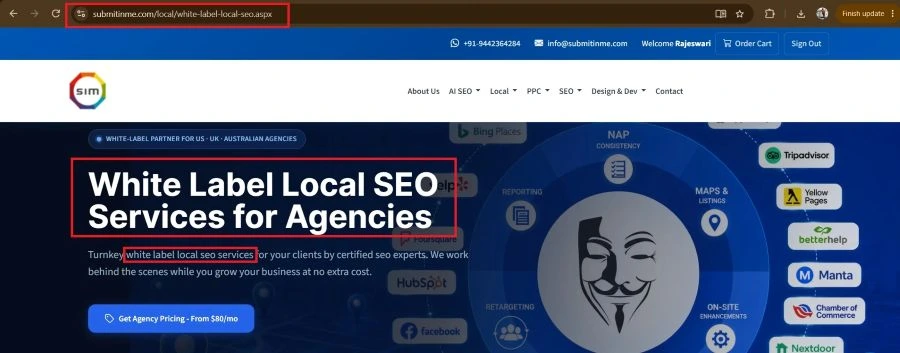
For instance, in case of the keyword “Local SEO agency”:
Title: Best Local SEO Company for Small Business
H1: Local SEO Agency for improve Local Visibility
URL: /local-seo-firm/
Opening: Our local SEO agency improves local visibility for small businesses on Google Search, Maps, Voice and AI.
This assists Google and users to understand the page's subject. The most important thing is to use the right words in the right places and give the visitors value added information, and not hide the value-added information behind too many keywords.
Google Business Profile and Spam Practices
The September 2026 Spam Update does not refer to Google Business Profile but is a Google Search ranking update. Google's SAFE research is interesting though because it tries to leverage content and pattern and relationships between content across content sources to set up an investigation of large-scale synthetic abuse.
This is a cautionary tale for local business to review Google Business Profiles and to be mindful of any practices that may be perceived as manipulative. Business names should not be stuffed with keywords to increase the frequency of searches for their business. For instance, it is not correct to change Sydney Flower Studio to “Sydney Flower Studio | Best Florist Sydney | Cheap Flowers Sydney | Same Day Florist.”
Fake reviews, fake engagement, duplicate building of citations, and information that isn't accurate should be avoided as well. SAFE's research also goes beyond text and can analyze multimodal information such as text, images and video. This is important as AI can now create large amounts of photos, videos, and other digital content very quickly.
Keep the business name genuine, use accurate information, select the right category and ensure that information and content associated with the business, such as photos, videos, descriptions, and other content, are real and useful.
Why the September Spam Update Matters to SEO Agencies
For SEO agencies, the Spam Update of September 2026 is significant because agencies typically work with several sites, local SEO projects, content initiatives, and a lot of business pages. An agency that generates content using AI or automation on scale must ensure the content is actually helpful and not just for the purpose of targeting more keywords.
The update also underscores the need to audit the following pages regularly within programmatic SEO: Pages, Location pages, AI generated content, backlinks and Google Business Profiles. Agencies should research if pages are helpful, if keywords are used naturally and if business information is accurate and consistent. If you have several clients, this's also a great time to keep an eye on Google Search Console and ranking data.
What to Do If You See an SEO Traffic or Ranking Drop
It's important to keep in mind that, if your website is seeing a drop in traffic or rankings after the Spam Update, it doesn't necessarily mean the reduction was triggered by the update. Google advises users to scrutinize their website and Search Console information to know what exactly has altered.
1. Check Google Search Console
The first step is to do comparisons between your website pre and post September 24. View clicks, impressions, average position, search queries, pages, countries and devices. This can be useful to find out if the decline is across the site or it is problems with certain pages, keywords or sections of the website.
2. Look for a Manual Action
Next, check the Manual Actions report in Google Search Console. A manual action is not an ordinary algorithmic change in rankings. If Google has taken action manually, Search Console will give you information about the problem and what you can do to fix it.
3. Audit Scaled Content
To review pages that have been generated by AI, programmatic SEO, automated translation, automated rewriting, templates for location pages or automated product pages. Ask yourself if each page has valuable content for visitors. Any pages with hundreds of identical pages, with only a new city, product or keyword name, should be carefully considered.
4. Check for Scraped Content
Be sure to look for content that has been copied or harvested from other sites on your website. Google's spam policies apply to abuses of scraping when the content is republished primarily with a view to influencing Search results. Changes in a few words from another web site is not necessarily a conversion of its originality or usefulness, so concentrate on adding your own information, experience, data, or insights.
5. Ensure that the site infrastructure is in good condition
A sudden ranking or traffic change may sometimes be due to a technical issue instead of spam. Verify indexing, XML sitemaps, canonical URLs, internal links, redirects, robots.txt, CMS-generated pages, search and filter URLs, subdomains and subdirectories. Look for rogue or compromised web pages. The policies of Google against spam include cloaking, doorway abuse, spammed content and efforts to circumvent spam policies.
What to Do If You See an SEO Traffic or Ranking Drop
It's important to keep in mind that, if your website is seeing a drop in traffic or rankings after the Spam Update, it doesn't necessarily mean the reduction was triggered by the update. Google advises users to scrutinize their website and Search Console information to know what exactly has altered.
1. Check Google Search Console
The first step is to do comparisons between your website pre and post September 24. View clicks, impressions, average position, search queries, pages, countries and devices. This can be useful to find out if the decline is across the site or it is problems with certain pages, keywords or sections of the website.
2. Look for a Manual Action
Next, check the Manual Actions report in Google Search Console. A manual action is not an ordinary algorithmic change in rankings. If Google has taken action manually, Search Console will give you information about the problem and what you can do to fix it.
3. Audit Scaled Content
To review pages that have been generated by AI, programmatic SEO, automated translation, automated rewriting, templates for location pages or automated product pages. Ask yourself if each page has valuable content for visitors. Any pages with hundreds of identical pages, with only a new city, product or keyword name, should be carefully considered.
4. Check for Scraped Content
Be sure to look for content that has been copied or harvested from other sites on your website. Google's spam policies apply to abuses of scraping when the content is republished primarily with a view to influencing Search results. Changes in a few words from another web site is not necessarily a conversion of its originality or usefulness, so concentrate on adding your own information, experience, data, or insights.
5. Ensure that the site infrastructure is in good condition
A sudden ranking or traffic change may sometimes be due to a technical issue instead of spam. Verify indexing, XML sitemaps, canonical URLs, internal links, redirects, robots.txt, CMS-generated pages, search and filter URLs, subdomains and subdirectories. Look for rogue or compromised web pages. The policies of Google against spam include cloaking, doorway abuse, spammed content and efforts to circumvent spam policies.
Final Thoughts
If you see a drop in rankings or traffic it's not your end, it could be theSpam Update coming from Google in September 2026. Continue to monitor Google Search Console and see which pages or keywords are impacted. Identify any issues with your content, keywords, technical SEO or Google Business Profile.
Don’t try to fix things by making drastic changes, make small steps. Make useful and creative content for people, don't spam. This can take up to 2 weeks to finalise so don’t make any decisions until Google and your site are updated.