AI is used by businesses to generate content at scale; the same technology is helping them create a large amount of low-quality content. Google is conducting research to come up with solutions to address the problem of low-quality content generated at scale.
SEO professionals should be interested in Google’s research in this area, as it helps businesses develop ways to handle issues that AI-generated content will create. With more websites using AI to generate massive content, the search engines need a way of separating good content from spam and abuse patterns. For businesses, this makes a well-planned SEO strategy increasingly important as search engines become better at evaluating content quality and identifying spam.
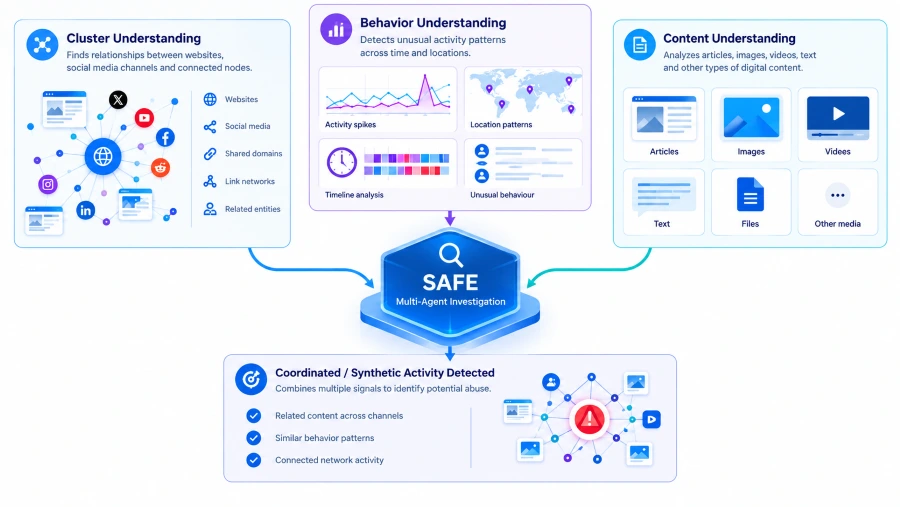
A Google research team has released information about SAFE, an automated multi-agent architecture designed to investigate abuse and AI slop in synthetic media.
Spam Detector SAFE (Scaled Abuse Forensics Examiner):
According to research by Google, generative AI has made it possible for malicious actors to produce and distribute large volumes of synthetic media through coordinated networks.
It raises challenges for existing techniques to detect such operations and is not necessary for a spam operation to always repeat the same piece of content. Instead, it can create its own versions of it with varying patterns underneath. SAFE is designed to analyse these patterns using it's automated multi-agent system.
SAFE Looks Beyond the Content
This is probably the most interesting part of the study for me. SAFE not only analyzes the content alone but also takes into consideration the architecture, which integrates various signals. It is capable of analyzing the content, behavior patterns, and relations between various channels to detect whether the traffic is part of a coordinated network.
SAFE is especially important for SEO because the creation and publication of content will become significantly easier with AI. In case more and more websites use AI when dealing with their content processes, there will be a need for algorithms capable of detecting patterns that can appear if the scale turns into spamming or abuse.
For SEO specialists, this fact means that the discussion on large content may become wider since analyzing the individual page may not be sufficient. Content production, distribution, and relations may offer some interesting signals.
The research of Google on the SAFE is one of the examples of the development of AI-based systems that can analyze such complex patterns of synthetic abuse.
Why This Matters for SEO Professionals
AI makes it much easier to create content at scale. And I can see why that sounds appealing to SEO teams trying to cover more topics and target more keywords. But there’s a catch: publishing more pages doesn't automatically mean getting more search visibility.
If a website suddenly starts producing hundreds or even thousands of pages, I think the more useful question is what those pages actually add for the person searching. AI can certainly help with the production side. But if the result is a lot of pages saying very little, the volume itself doesn't really solve the SEO problem.
For me, that's the interesting part. The focus shouldn't just be on how much content we can create, but whether there is a good reason for that content to exist in the first place.
The Shift from Content Detection to Pattern Detection
AI-generated content does not need to be identical each time it is generated. The spam network could generate several variations of the same article, video, or other media rather than repeating the same article over and over. This study reveals how difficult it can be to recognize synthetic content that comes in several variations.
SAFE, however, takes a different path by using several types of evidence together. That makes the relationships around content more interesting.
Valuable Content Can Stand Out from AI Automation
The first and foremost takeaway from the SAFE research is the revelation made by Google regarding the identification of AI-Generated content. It has become comparatively easy to generate thousands of pieces of content, but the question is not whether one sentence was written using AI, but rather the bigger picture of how this happens. This is what makes the multi-modal approach proposed by Google in its SAFE research appealing.
In terms of SEO, the takeaway message is very clear: AI-generated content is different from really valuable content. Websites that have much useful information and original ideas will get an edge over those that focus on automation.
While writing this article, I suddenly had a question in my mind. Every writer has their own style and patterns. Some people naturally write short sentences, while others prefer longer ones. We all have certain words, phrases, or ways of explaining things that we tend to use again and again.
So, what happens if a system detects those patterns and assumes they are signs of AI writing? A pattern alone doesn't necessarily mean that AI was involved. It becomes more meaningful when it is looked at alongside other signals that may point to coordinated or large-scale activity. This is also what makes SAFE's broader approach interesting to me, rather than simply trying to decide whether one sentence looks AI-generated.