Are you running a small business and finding yourself spending too much time managing marketing, content, customers, and different business tools? Then you might want to hear about Meta’s latest announcement on Muse for Small Business.
When I saw the announcement from Meta, it wasn’t another launch of an AI chatbot. I had already been following Muse and its approach to privacy and personal data, so this new update caught my attention for a different reason. Meta is now bringing Muse into small-business workflows, where it can connect with tools businesses already use, including Facebook pages, Instagram professional account analytics, Meta Ads, Shopify, Stripe, and more.
Meta announced Muse for Small Business on September 29, 2026. Instead of asking AI one question at a time, a business owner can give Muse a bigger goal, such as improving advertising, planning content, understanding business performance, or growing the business. Muse can then work across connected apps and services to help move that goal forward.
Meta Is Turning Muse into a Small Business Assistant
I think the interesting part of Muse is the way Meta describes it. It is not designed only to generate a caption or answer a business question. According to Meta, small businesses can give Muse a goal and let it work across connected tools.
For example, a small business owner could ask Muse to look at sales, campaigns and social activity and create a growth plan for the next year. Another use case Meta highlights are asking Muse to analyze what is working in ads and content, look at trends and prepare a campaign for the following week.
That changes the conversation around AI for small businesses. Instead of thinking, “What prompt should I give AI today?”, the small business owner can think, “What do I need to get done?” and give that goal to an agent.
Muse Can Connect with the Tools Small Businesses Already Use
Muse is designed to connect with a growing list of tools instead of operating completely on its own. Meta says Muse can connect with Asana, Figma, Klaviyo, Shopify, Slack, Stripe and Zoom. It can also connect with Facebook Pages, Instagram professional account analytics and Meta ad accounts.
If you want to try Muse with your Facebook Page, the connection process is designed to be straightforward.
Step1: Open the Muse app or go to muse.ai and sign in.
Step2: Go to the Settings section inside the Muse app.
Step3: For Facebook, select the Facebook Pages connector.
Step4: Choose Facebook Page and click connect
Step5: Sign in with the Meta account that manages the Facebook Page and complete the authorization
Step6: Once the connection is completed, Muse can work with your connected Facebook business information
After all these steps done, you can ask Muse about your Facebook Page, such as which posts are performing well, how engagement is changing, and what content you could post next
To know: The same process applies to the other available connections. Just choose the connector you want and follow the sign-in and authorization steps.
Meta Ads Are Part of the Muse Experience
Agency who working in Meta Ads, this is the part that immediately stood out to me. Muse can connect to Meta advertising accounts, along with Facebook Pages and Instagram professional account analytics. Meta says the agent starts with an understanding of the business, including what the company sells, how the brand communicates and what customers repeatedly ask about.
For example, instead of manually copying campaign information into an AI tool and explaining the business every time, a connected Muse setup can work with the business context already available to it. Meta specifically highlights a use case where Muse can analyze ads and content, identify what is working or not working, look at trends and draft a campaign for the following week.
Of course, I would still want a human marketer to review campaign recommendations before anything goes live. But the interesting shift is that AI is moving closer to the actual marketing workflow rather than sitting outside it.
Shopify, Stripe and the Move Toward Agentic Commerce
The Shopify and Stripe connections also caught my attention because they take Muse beyond content and productivity.
Muse can connect with Shopify and Stripe, alongside other business tools. This is where I see the conversation moving toward agentic commerce. AI is increasingly being designed not just to tell people what to buy, but to help businesses manage the steps around selling, payments, customers and operations.
For ecommerce businesses, this could eventually mean an AI agent helping with everything from identifying a business opportunity to preparing content, reviewing performance and working with the connected systems needed to operate the store.
It is still early, so I would not treat Muse as a replacement for an ecommerce team or marketing agency. But the direction is certainly interesting.
Muse Still Keeps the Business Owner in Control
One point I would not skip is the approval system.
Meta says that nothing publishes, sends or spends without the user's approval. The Muse website also says users can see an audit trail showing what the agent has done and what it plans to do.
This matters because an AI agent that can access business systems needs a different level of control from an ordinary chatbot. Imagine asking an AI to prepare a campaign. Preparing the campaign is one thing. Publishing it, sending messages to customers or spending advertising money is another.
Muse's current approach is to let the agent do the work while keeping the final approval with the business owner.
Muse Can Also Work in the Background
One thing I found interesting about Muse is that I can give it a goal and let it work across connected apps and services, even after I close it. This feels different from the usual AI experience, where I ask something, get an answer, and then give another prompt for the next step. Muse makes it more like you're assigning someone a task and letting them do the work.
Small business owners can use it to see how their business is doing, organize information, plan content, review campaigns or identify tasks that need attention. Instead of doing everything step by step, they can give Muse the main goal and let it work through the connected tools.
What This Means for Digital Marketing Agencies
From my perspective, this is where Muse for Small Business becomes interesting for digital marketers. Small businesses already use AI to write social posts, create ideas, and prepare marketing content. Muse could go further in helping companies work with the tools and information they already use.
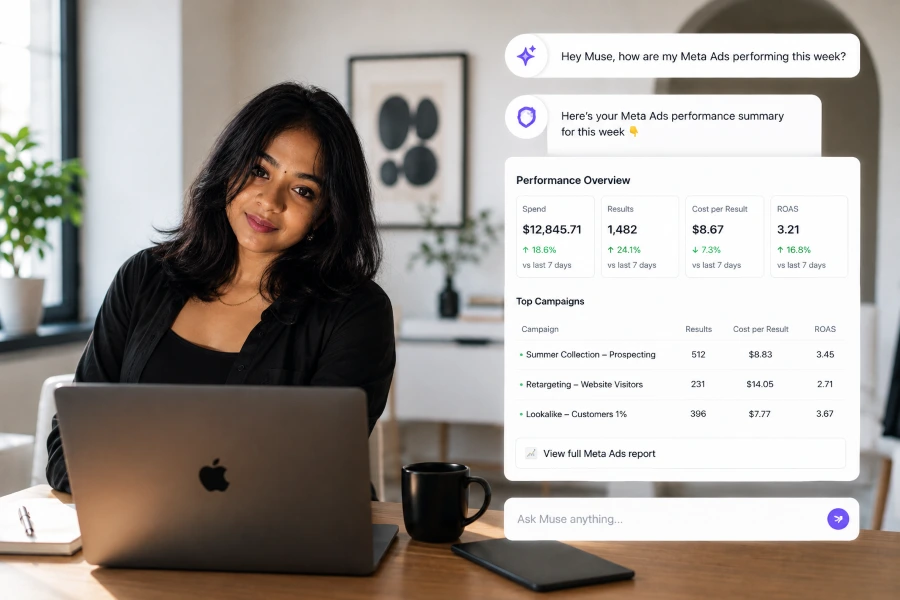
A business owner, for example, might use Muse to check the performance of a campaign, to look at social media activity, to manage content tasks, or to spot any gaps that need attention. This could reduce some of the repetitive work that usually takes up a marketer’s time.
But I don’t think this means digital marketers will become less important. But marketers would still need to understand the audience, review the recommendations AI makes, select the appropriate targeting, optimize campaigns, and make sure the marketing activity is actually delivering results.
Want to explore how AI can fit into your marketing workflow?
Chat on WhatsApp +91 94423 64284
So, the benefit for digital marketers could be simple: AI does more of the routine work, while marketers can spend more time on the work that requires human thinking, creativity and strategy.
My Take After Reading the Muse Documentation
After reading Meta's announcement and the Muse business documentation, I don't see Muse as just another AI personal agent. What I find interesting is that it can connect with the tools a business already uses and help with different business tasks.
Muse can work with social media advertising, ecommerce, finance, and other business tools, while the business owner still approves important actions. It can even help with things like reviewing financial performance and identifying expenses that may need attention.
Another useful point is that Muse is free for most of what people need, with subscription plans available for those who want more. Muse for Small Business is currently available to people 18 and older in the US and Canada, and Meta says it plans to bring Muse to more markets.
I think it will be interesting to see how small businesses use Muse for marketing and everyday work in the coming months.