Business owners are used to a simple search model: a customer types a keyword, Google shows results, and optimized pages compete for clicks. That still matters, but AI search now reads a question, breaks it into related searches, compares sources, and produces an answer before the user clicks a website.
This is where Query Fan-Out Optimization becomes important. It is the practice of preparing your website and wider digital presence for the many hidden sub-queries an AI search engine may run while building an answer.
For a business, this changes the goal. You are not only trying to rank for one keyword. You are trying to become useful across the questions, comparisons, proof points, and local details that surround it.
What Query Fan-Out Means
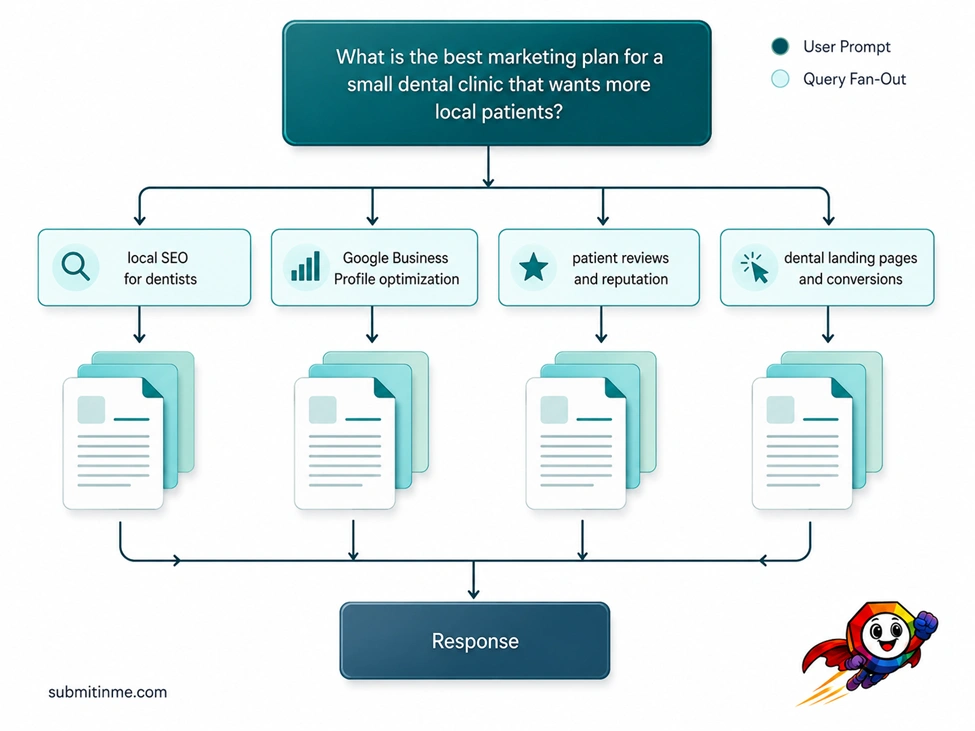
Query fan-out happens when an AI system expands one prompt into multiple related searches. If someone asks, "What is the best digital marketing plan for a small dental clinic?" the AI may explore local SEO for dentists, Google Business Profile optimization, patient reviews, AI search visibility, citation building, and landing pages.
The user sees one clean answer. Behind it is a wider research path. If your business is visible only for a narrow keyword, you may be missed. If your content covers the surrounding intent map, your brand has more chances to be retrieved and cited.
How It Fits into Generative Engine Optimization
Query Fan-Out Optimization is not a separate replacement for SEO. It is a practical layer inside Generative Engine Optimization, or GEO. GEO focuses on helping a brand appear in AI-generated answers across platforms such as Google AI Overviews, AI Mode, ChatGPT Search, Perplexity, Gemini, and Copilot.
Traditional SEO helps search engines crawl, index, and rank your pages. GEO helps answer engines understand, summarize, and trust your business. Query fan-out is the bridge because it shows how AI systems gather evidence before recommending a company or service.
That is why business owners should see GEO as a step above conventional SEO. The basics still matter: technical health, useful content, internal links, clean service pages, consistent business information, and authority. But AI search adds a new requirement. Your content must be answer-ready and connected across a topic, not just optimized around one phrase.
For businesses beginning this shift, GEO services and foundational SEO services should work together rather than compete for budget.
Why AI Search Makes This Necessary
The adoption of AI search engines changes how customers make decisions. People now ask full questions, request comparisons, and expect summarized recommendations. They may read an AI answer, shortlist two brands, and move directly to a call, map listing, or review profile.
This creates a visibility gap. A business can rank well in classic search but still be absent from AI-generated answers. The reason is often not one missing keyword. It is weak coverage across the related questions AI systems use to build confidence.
For example, a roofing company may optimize for "roof repair in Dallas." But an AI answer about choosing a contractor after storm damage may also look for licensing, insurance claims, emergency leaks, reviews, cost estimates, local experience, and repair-versus-replacement guidance. Query Fan-Out Optimization helps the business show up across that wider path.
Traditional SEO vs Query Fan-Out Optimization
|
Area |
Conventional SEO |
Query Fan-Out Optimization |
|
Primary focus |
Ranking pages for target keywords. |
Covering the connected questions AI search may investigate. |
|
Content approach |
Service pages, blogs, and keyword mapping. |
Topic clusters, FAQs, comparisons, proof, and answer-ready sections. |
|
Authority building |
Backlinks and domain authority signals. |
Relevant links, mentions, citations, reviews, and entity clarity. |
|
Best outcome |
More rankings and clicks. |
Stronger chance of being included in AI-generated answers. |
Why It Can Beat Old Link Building
Link building has always had a place in SEO, but the way it is often executed has become a problem. Too many campaigns still rely on irrelevant guest posts, thin article placements, generic blogs, and content written only to hold a backlink. A link from an unrelated article may create a signal, but it rarely helps an AI engine understand why your business belongs in a specific answer.
Query Fan-Out Optimization makes authority building more intentional. Instead of asking, "Where can we place a link?" it asks, "Which related questions must our brand be associated with for AI search to trust us?"
A financial advisor does not only need links around "financial planning." The fan-out map may include retirement planning by age, tax-efficient investing, risk profiles, estate planning basics, local reviews, fee comparisons, and education resources. Mentions, citations, expert quotes, and links inside those contexts can be more valuable than unrelated placements.
This is where smart digital PR and press release distribution can support GEO when the story and placement are relevant. The advantage is clear: a fan-out plan builds evidence across the same topics AI engines are likely to research, while old link building often builds disconnected signals.
A Practical Plan for Business Owners
Start with customer questions. List the searches people make before they choose you: problems, comparisons, prices, risks, alternatives, locations, reviews, and proof. Sales calls, review text, competitor pages, and Search Console can reveal this language.
Next, group those questions into clusters. A local clinic may need clusters for treatments, insurance, doctor expertise, location, reviews, pricing, aftercare, and appointments. A SaaS company may need clusters for integrations, pricing, alternatives, onboarding, security, use cases, and ROI.
Then improve your pages so they answer the cluster, not just the keyword. Add definitions, comparisons, FAQs, examples, case studies, reviewer details, pricing context, and clear internal links. Make it easy to understand what you do, who you serve, and why you are credible.
Finally, build relevant external context. Look for industry publications, directories, partner pages, customer stories, podcasts, review platforms, and useful media mentions. The aim is not volume. The aim is a consistent, verifiable story across the web.
What to Measure
Old SEO dashboards focus on rankings, traffic, backlinks, and conversions. Keep those metrics, but add AI visibility checks. Search priority questions in AI tools and record whether your brand appears, which competitors are mentioned, and what sources are cited.
Also track content gaps. If AI answers mention topics your website does not cover, that is a content opportunity. If competitors appear because they have stronger reviews, better comparison pages, or clearer local signals, that is a visibility opportunity.
Over time, the most useful metric may be share of answer: how often your brand appears across commercial AI prompts. This is still an emerging measurement area, but it fits the way customers now search.
The Takeaway
Query Fan-Out Optimization is not a buzzword to replace SEO. It is a clearer way to plan for how AI search gathers information. Business owners who understand it can move beyond keyword pages and random backlinks toward a stronger, more connected digital presence.
The future of search will reward businesses that are easy to understand, easy to verify, and useful across the whole decision journey. At SubmitInMe, we help businesses build that system with SEO, GEO, content updates, citations, and authority signals working together, so customers find the right answer faster.