I think one of the biggest changes happening in search right now is not just where people search, but how they search.
For years, digital marketing agencies have been trained to think in keywords. Find a popular keyword, check the search volume, create a page around it and try to rank. That approach still has value, but I don't think it tells the full story anymore.
People are becoming much more specific about what they want.
Instead of searching for something broad like “digital marketing for florists,” someone may now search, “What is the best digital marketing strategy for a florist in Sydney, Australia with a $2,000 monthly marketing budget?” That second search tells me much more about the person, their situation, their expectations and possibly even how close they are to making a decision.
For agencies managing SEO, and content for clients, I think this change deserves much more attention because people are not just searching with keywords anymore; they are asking detailed questions and expecting more specific, relevant answers. This is where AISEO comes in, helping agencies think beyond traditional keyword targeting and focus on how their clients can be discovered through AI-driven search experiences.
Question-Based Searches Have More Than Doubled
According to an Neilpatel Digital survey of 1,000 people, question-based searches increased from 8% in 2023 to 21% in 2026. That represents a 163% increase in the share of searches being phrased as questions.
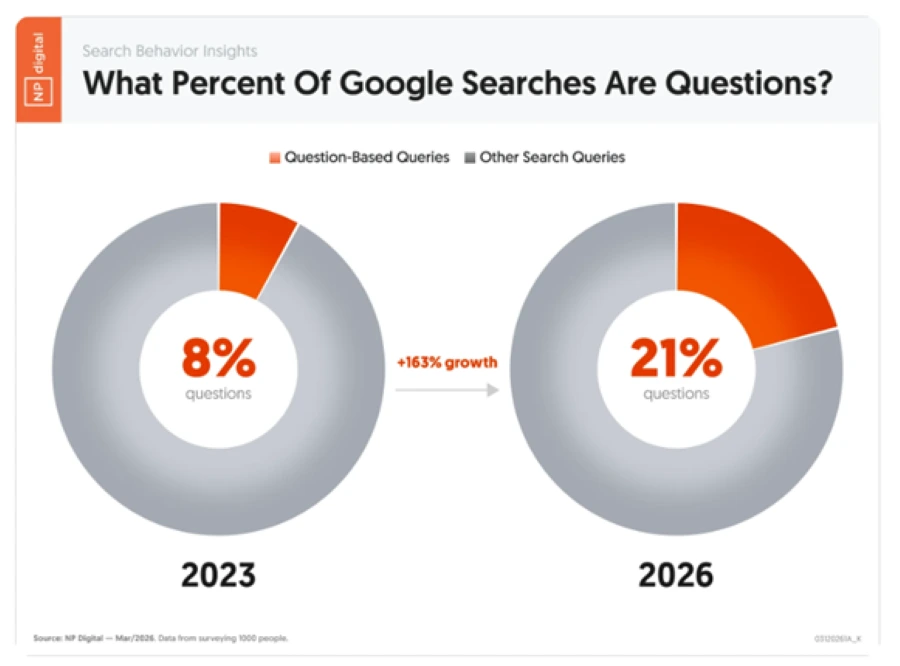
For me, this shows that search behavior is becoming more conversational and focused on what people actually want. Three years ago, very specific searches were harder for search engines to understand, but today they are much better at understanding the context behind a question and showing a relevant answer, product or service. This also changes how I look at content. When someone asks a detailed question, they are not looking for a page filled with keywords. They want a clear answer that directly matches what they are asking.
People Are Moving from Keywords to Conversational Questions
I still see digital marketers spending a lot of time focusing on high-volume keywords. There is nothing wrong with that because keyword research is still important. The problem is assuming that one popular keyword represents every way a customer might search for a product or service. It doesn't.
For example, someone looking for Amazon advertising services might search for “Amazon Shopping Ads.” Another person might ask, “How much does it cost to run Amazon Shopping Ads for a small e-commerce business?” Both are looking for Amazon advertising, but the second question tells me much more about what the person actually needs, including their budget and business size. That’s why I think marketers need to go beyond popular keywords and understand the specific questions their customers are asking.
The Exact Question Can Reveal the Exact Buyer
When I work on content for digital marketing agencies and their clients, I don't want to focus only on what people search for the most. I also want to understand what they are actually trying to solve. When someone searches for “GEOSEO agency,” they give me one piece of information, but when someone asks, “How can an GEOSEO agency improve my website’s visibility in ChatGPT,” they give me so much more context. They already know what they are looking for, they have a specific problem and they may be closer to choosing a service.
Want to improve your AI search visibility?
Chat on WhatsApp +91 94423 64284
This is why I think question-based searches are important for AISEO. When people ask a question they expect to receive an useful answer. If an agency creates content that directly answers that question instead of simply targeting a popular keyword, it can build trust and move the person further towards taking action. For me, this is where search can move from visibility to conversion. The right question brings the right audience, and useful content can help turn that search into a lead, enquiry or customer.
How to Prepare a Website for Conversational Search
This also means we need to think differently about how we prepare websites for conversational search. I would not start creating content around keywords, but instead would focus on creating good, usable content that actually answers the questions that customers are asking.
- Homepage: The business page must clearly explain what the business does who it helps and what problems it solves. Make the information simple and easy to understand. Use an H1 heading that shows the purpose of the page. Also add a title and meta description that explain the business and make people want to click from search results
- E-E-A-T: Display Experience, Expertise, Authoritativeness and Trustworthiness across the site. For businesses looking for leads show team expertise, client results, case studies, real reviews and clear business information. For stores show real product reviews, detailed product info expert help with payment and return policies and reliable customer support. These signals make the customer more confident and they help search engines see that the site is trustworthy.
- Service and product pages: Answer questions about each service or product such as pricing, benefits, process, use cases, features and common customer worries. These pages should give useful information so someone can decide if the service or product is right for them.
- Contact page: Show the business name, location, phone number, email address, business hours and contact options clearly. Also explain what customers can contact the business about, such as asking for a quote booking a meeting or asking about a service.
- About Us page: Clearly talk about the company’s experience how long it has been around the team and the background. helps users and artificial intelligence systems understand who is behind the information.
- Reviews section: Add real customer reviews discussing service, experience and results. This gives new customers a chance to get to know the business and builds trust.
- FAQ sections: Add questions customers often ask and give helpful answers. FAQs can be on the service and product pages of putting all questions on one general FAQ page.
- Blog pages: Write content about specific questions, problems, comparisons and situations customers look for before making a decision. This is a place to cover longer and more casual searches.
- Author information: For blogs and educational content show the authors name, role experience and social profile if it is relevant. This helps show who made the content.
- Case studies: Show how the business has fixed customer problems. Include the situation, approach, screenshots and results to show experience and give AI systems info about the business.
- Last updated information: Show the date when important articles, guides and pages were updated if the info changes often. This helps users know if the info is up, to date.
- Location pages: For businesses include the services offered the areas served, location info and questions customers in that area might ask. This can be very helpful for search and AI recommendations.
- Comparison pages: Make comparisons for customers choosing between products, services or solutions. For example, an agency could write about 'Google Ads vs Meta Ads: Which's better, for generation?'.
- Pricing pages: Answer questions about costs, plans, what is included and the factors that can affect pricing. These questions can also indicate strong buying intent.
- Product/service schema: Use data to help search engines better understand details of products, services, reviews, pricing and business information.
- Consistent Local Business information: Verify that the company name, address, phone number, website and other business details are the same across the website.
- Conversion pages: Make it clear what to do next after someone finds the answer they need. Conversion pages should contain options to request a quote, book a consultation, contact the business, or make a purchase.
- Internal links: Should be natural and help users transition from one question or topic to another. Internal linking also helps search engines understand the relationship between content.
- Ecommerce images and videos: Should have product images, product demonstration videos, size or fit visuals, and comparison images to help shoppers understand the product before buying. Images and videos should also have alt text that describes what the image is showing.
- Footer: Include the copyright year, quick links, social media profiles, privacy and other policies, business address and important contact details. Footer makes key information easy to find. Improves the user experience.
- Remove old information: Check the website regularly and remove expired offers expired promotions, pricing, discontinued products and any information that is not accurate anymore.
- GBP pin location: Be accurate on the map for the Google Business Profile pin. GBP pin location should match the business address shown on the website and other online listings.
Final Thoughts
Search is changing because people are changing the way they search. They are asking specific questions and expecting clear and useful answers.
For marketing agencies, I think it is important to look beyond just website content and keywords. Check the website, Google Business Profile (GBP) and other business listings to make sure that the information is correct and up, to date.
The goal is simple: make the business easy to understand wherever people search for it. This can help the business appear in search Google Maps and AI-powered search experiences.
For me this is where AISEO fits into the search strategy. It is not about ranking a website. It is also, about making sure the right information is available and useful when customers ask questions.