Your press release may have a new reader before a journalist, customer or prospect ever gets to it.
That reader is AI.
Imagine Rachel Miller, who runs a growing skincare brand in Chicago.
She is preparing to launch a mineral sunscreen designed for sensitive skin, and she wants more than a brief burst of attention. She wants potential customers to discover the product when they are actively looking for something like it.
So Rachel issues a press release. She is still writing for people, but search engines and AI-driven systems that crawl, index and retrieve information from across the web may encounter it first.
Rachel’s Business Problem is Visibility
Rachel’s sunscreen may be exactly what a customer needs. That does not mean the customer knows it exists.
Advertising can create awareness. Search optimization can help customers find relevant pages. Social media can build an audience.
But press releases serve a different purpose: they turn business developments into public information that can travel beyond the company’s own website.
Google says queries in AI Mode are about three times longer than traditional searches, with people increasingly asking conversational follow-up questions. Instead of searching for “mineral sunscreen,” Rachel’s future customer might ask:
What are some recently launched mineral sunscreens for sensitive skin that don’t leave a heavy white cast?
First, the Machine Needs Something Useful to Read
For Rachel’s brand to be relevant to that question, clear information about the new product needs to exist somewhere online. This is where the quality of the press release matters.
Rachel could announce the launch like this:
Rachel’s company is excited to unveil an innovative new product that is redefining modern skincare.
It sounds like marketing. It tells a machine (or a customer) almost nothing. Now consider:
Rachel’s Chicago-based skincare company has launched a mineral SPF 50 sunscreen formulated for sensitive skin, designed to provide broad-spectrum protection with a lightweight finish.
The second version establishes the company, product category, SPF, intended customer, location and key product characteristics. It gives a search system something concrete to understand.
Good optimization is not about forcing the same phrase into every paragraph. It is about removing ambiguity around what the business is announcing and why it matters.
Names, product categories, locations, dates, audiences, and supporting facts all count. The easier a press release is to understand, the more useful it is to both human and machine readers.
Next, Distribute the PR to Reach the Right Audience
Publishing the release on Rachel’s website creates one source of information. Distribution gives it a chance to travel further.
A press release distribution strategy typically takes an announcement beyond the company newsroom and through online news, publication and syndication channels.
Depending on the service and the story, journalists, publishers and other sites may discover or reference it.
Rachel cannot expect every potential customer, or every search system, to begin at her website. Once the release is distributed, a publication may pick it up, a beauty industry site may cover the product independently, and a blogger might later include the sunscreen in a roundup.
None of that is guaranteed, but the announcement now has far more opportunities to be discovered.
AI Search Will Now Change What Happens Next
The scale of AI-assisted search makes this more important.
Google has reported that AI Overviews now reach more than 2 billion monthly users across over 200 countries and territories, and that AI Mode has passed 1 billion monthly users.
For Rachel, the point is not that an AI system is guaranteed to quote her press release. It isn’t.
The opportunity is that she has created clear, public information that both traditional and AI search systems can potentially discover alongside her website, publications, and other sources.
From Brand Discovery to Conversion
A few weeks later, a customer named Sophia is researching sunscreens for sensitive skin. She has never heard of Rachel’s company.
But an AI-assisted search surfaces the brand through its website, press release, syndicated content or later media coverage. That creates the first point of discovery.
Sophia then searches the brand, visits the website, and finds the same product details repeated clearly across different sources. She may also come across independent coverage of the launch.
This consistency helps move discovery toward trust. A product page alone relies on the company’s own claims. A dated announcement, matching information and relevant third-party coverage give Sophia more context and confidence about Rachel’s brand.
This is where a press release earns its value. Rather than serving only as a source of backlinks, PR can improve visibility, support credible coverage, and give potential customers more reasons to trust what they find.
Look at what a press release can contribute when it is treated as part of a wider brand discovery strategy.
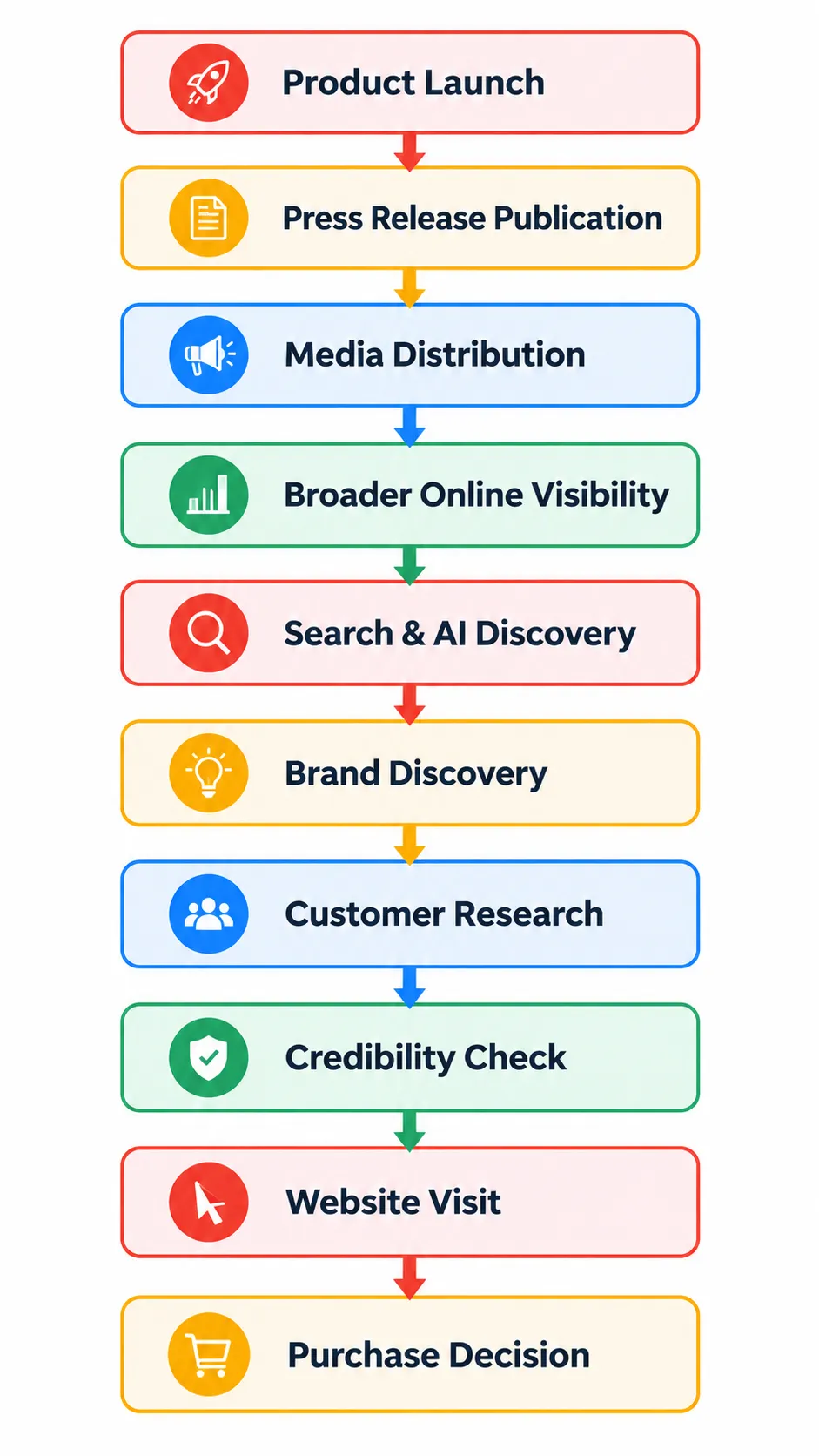
PR cannot control the whole journey, but it can help create a stronger starting point for it.
Write for People, Knowing Machines May Read First
Write press releases for people first, but structure them so machines can quickly understand them too. The goal is not robotic writing. It is clear, specific writing that serves your audience.
AI is the New Reader. But Human is Still the Goal
Rachel did not publish her press release because she wanted an AI system to admire it. She published it because she wanted more people to discover her product.
What has changed is what may happen in between. A search engine can crawl the announcement, an AI-powered system can process it alongside other information on the web, and a journalist or publisher can discover the story.
These interactions can make Rachel’s company easier to find when someone eventually asks the right question.
The machine reader is not the end audience. It is becoming part of the route to that audience. What matters is whether that helps the right human find you next.
Ready to put your next announcement in front of the right readers? Explore SubmitInMe’s press release distribution services.