Google AI Overviews are changing the relationship between search visibility and website traffic. New research suggests that appearing as a cited source inside an AI-generated answer may give a brand exposure without producing the click marketers once expected from a prominent search result.
For businesses investing in SEO, content marketing and Generative Engine Optimization (GEO), that changes what search success looks like. Ranking still matters, but so does whether your brand is being surfaced and trusted when Google answers the query without sending the user to your site.
What the Research Found
A study by Athena Chapekis, Anna Lieb, Sono Shah, and Aaron Smith — Chapekis et al., “Investigating Click Behaviors on Google Search Result Pages That Produce an AI Overview,” IC2S2 2026 — analyzed one month of browsing behavior from a representative panel of 900 U.S. adults. Across 91,121 visits to Google Search pages, the researchers found that about 18% generated an AI Overview.
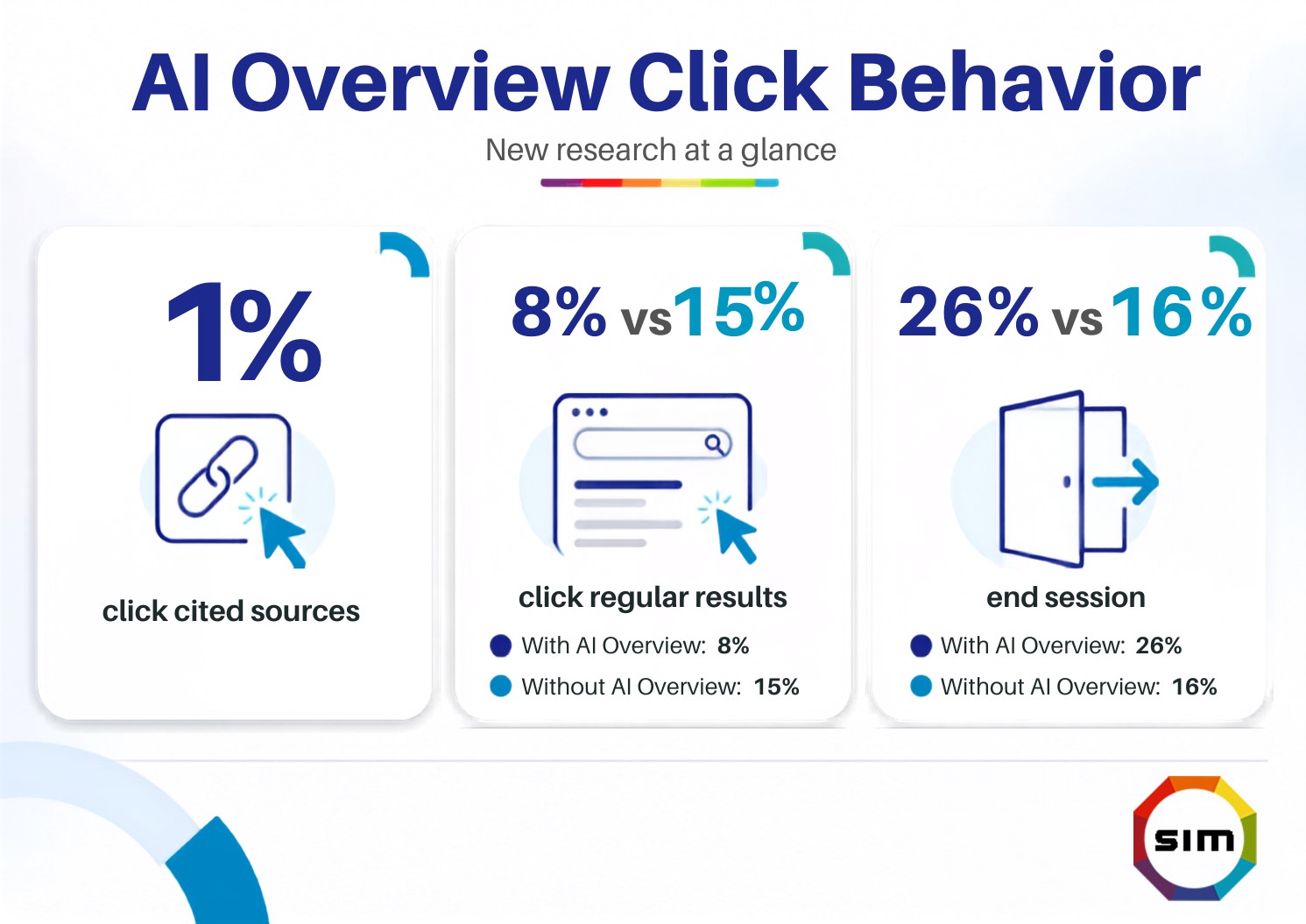
Only about 1% of visits to pages containing an AI Overview resulted in a click on a source cited inside the overview. Users clicked a regular search result on 8% of visits with an AI Overview, compared with 15% of visits without one. They also ended their browsing session after 26% of searches with an AI Overview, versus 16% without one.
The researchers are careful about what these numbers mean. Because the study is observational rather than experimental, it does not establish that AI Overviews directly cause fewer clicks. It does show a significant association between AI Overviews and different search behavior.
Search Visibility Is Separating From Search Traffic
For years, organic search performance followed a familiar path:
Visibility → Click → Website Visit → Conversion
AI-generated search results complicate that sequence.
A page can now influence an answer without becoming the user's next destination. A brand may be cited, summarized or mentioned while Google remains the primary interface.
This makes zero-click search more important to understand, but it does not make website traffic irrelevant. Instead, marketers need to separate two outcomes that were once closely connected: search visibility and website visits.
An AI citation can be valuable, but its value should not automatically be treated as equivalent to organic traffic.
Book a Free Strategy Call
SEO Still Builds the Foundation
Traditional SEO remains important because AI systems still need accessible, relevant and authoritative information to work with.
Strong page structure, clear search intent, technically accessible content, useful internal linking and credible subject matter remain valuable whether the immediate result is a conventional ranking or an AI-generated answer.
For businesses, this means established SEO services should not be replaced by an AI-only strategy.
The stronger approach is to improve the underlying search presence while adapting content for new answer environments.
That is where Generative Engine Optimization (GEO) becomes important. GEO focuses on making content easier for generative systems to understand, extract and potentially cite.
Clear answers, concise explanations, structured content, well-supported claims and identifiable expertise can make a page more useful within AI-driven search experiences.
What Should GEO Optimize for if Citations Do Not Get Clicked?
The 1% finding creates an important measurement question.
If AI Overview citations rarely produce immediate visits, what should AI search optimization actually aim to achieve?
Create content around specific questions
Longer queries and questions were more likely to produce AI Overviews in the study. Marketers should therefore build content around precise user needs, natural-language questions and detailed search intent rather than relying heavily on broad keyword targeting.
Generic summaries offer little differentiation. Original data, expert commentary, clearly attributed facts, comparisons, definitions and concise explanations give search systems more distinctive information to reference.
Protect conventional search demand
Not every query will be satisfied by an AI answer. Commercial, transactional, branded and high-consideration searches can still create valuable website visits.
GEO should complement SEO rather than compete with it.
Expand measurement beyond organic sessions
Rankings and clicks remain important, but brands may also need to monitor branded searches, search impressions, assisted conversions, referral patterns and appearances inside AI-generated responses.
Local SEO May Need a Broader Definition of Success
The shift is particularly relevant for local businesses.
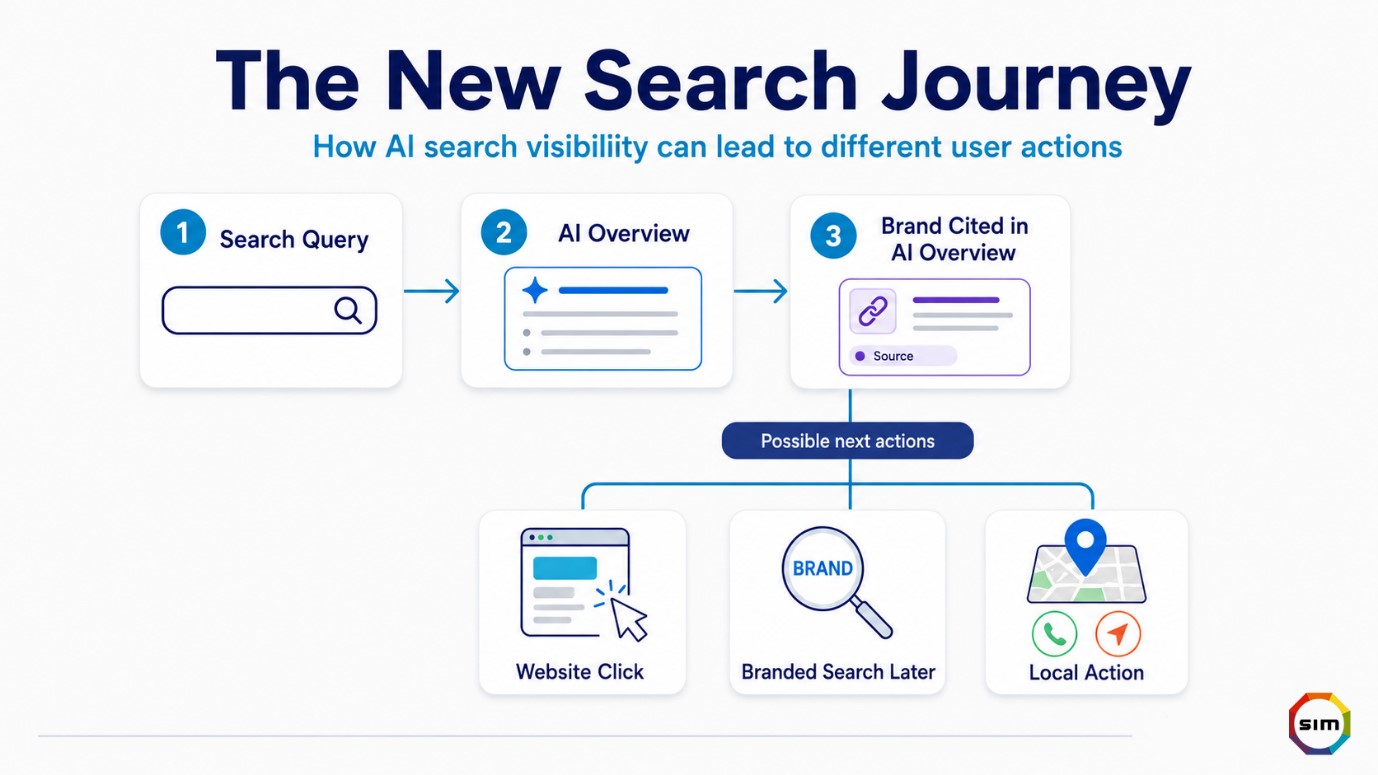
A search does not always need to produce a website visit to produce business value. A prospective customer might discover a company, recognize its name, look for directions, call directly or return later through a branded search.
This means local SEO services should be assessed across more than organic website sessions.
Accurate business information, strong local citations and Google Business Profile optimization can help businesses remain discoverable at points where customers are making local decisions without necessarily entering through a traditional organic result.
For local marketers, the objective is not to force every search into a website click. It is to make the business easy to find, verify and choose wherever the decision occurs.
The KPI Shift Marketers Should Prepare For
The research does not suggest that clicks have stopped mattering.
It suggests that a click-only view of organic search may become less complete.
Search teams should increasingly distinguish among ranking visibility, AI citation visibility, website traffic and conversion impact.
A citation that produces no immediate visit may have little value in one context and meaningful brand value in another. The important question is whether that exposure contributes to discovery, consideration or customer action.
SEO therefore needs better attribution, not lower standards.
Book a Free Strategy Call
SEO and GEO Are Becoming a Two-Layer Search Strategy
Google AI Overviews add another layer between a user's question and a publisher's website. The 1% citation-click finding makes that layer difficult for marketers to ignore.
Businesses still need strong SEO to remain discoverable in traditional search results. They increasingly need GEO principles to make their information clear and usable within AI-generated answers.
The opportunity is to connect both disciplines while measuring the business outcomes that follow.
SubmitInMe helps businesses build integrated SEO, GEO and local search strategies for a search environment where rankings, citations and customer discovery increasingly overlap. Explore our Generative Engine Optimization services to assess how ready your content is for traditional search and AI-generated answers.